
Kit (ConvertKit) Alternatives in 2026: 7 Options Compared, With Real Prices
Kit is free up to 10,000 subscribers, but the bill, the per-sale fee and the plain newsletter page add up. Seven Kit alternatives compared on price at 1,000 and 10,000 subscribers, fees on paid subscriptions, and what each one is best for.

Michal Wlosik
· 11 min read
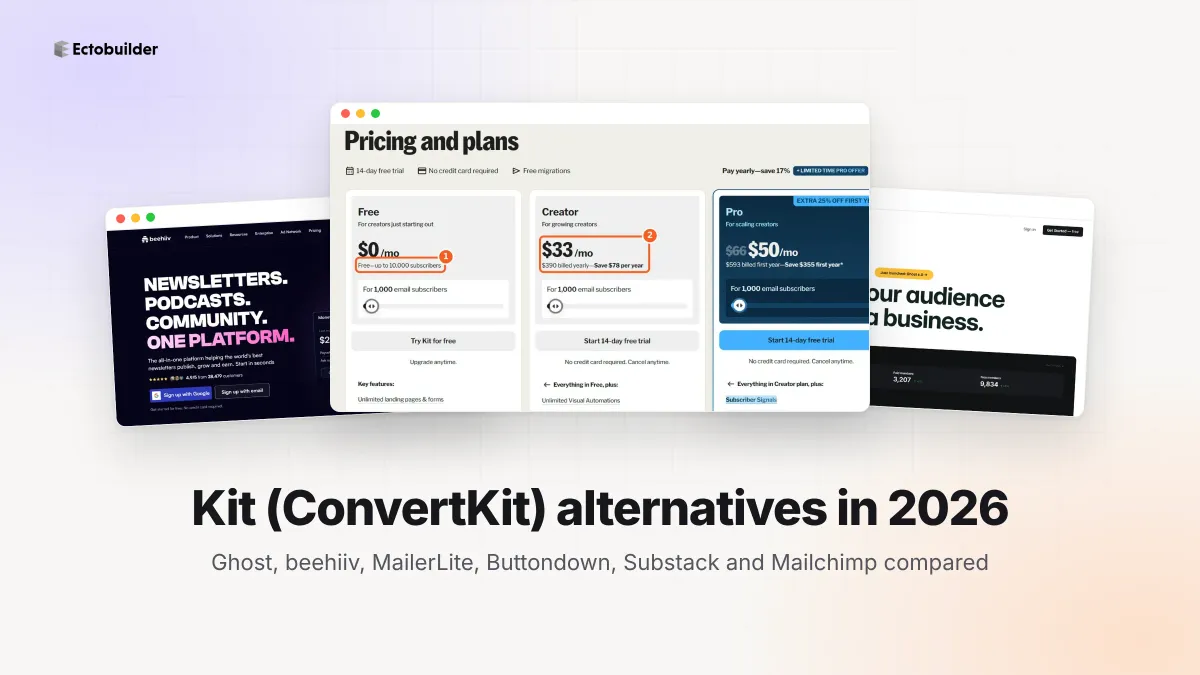
Kit, which most people still call ConvertKit, is very good at one thing: email marketing for creators who sell. Tags, segments, visual automations, landing pages and a store are all there. If your newsletter is a funnel for a course or a coaching offer, it's hard to beat.
Writers who just want to publish a newsletter often feel differently. The free plan has only a basic automation, the paid plans climb quickly as your list grows, every sale carries a fee, and the newsletter page Kit gives you looks like everyone else's. If that sounds familiar, here are seven Kit alternatives worth looking at in 2026, with what each one actually costs.
Prices are in US dollars, on monthly billing unless noted, for about 1,000 and about 10,000 subscribers. They were checked on each platform's own pricing page in October 2026. Where a figure came from a third-party price tracker, we say so.
The short answer
- Ghost: you want a real website with your own design, paid memberships with 0% cut, and software you can take anywhere.
- beehiiv: you want to grow fast and earn from ads and sponsors. Free up to 2,500 subscribers.
- MailerLite: you want Kit-style automations and forms for less money.
- Buttondown: you want the simplest, cheapest tool for a writing-first newsletter.
- Substack: you want to start free and be discovered inside an app, and you accept a 10% cut.
- Mailchimp: you run a business and need general email marketing, not a publication.
- Stay on Kit if your newsletter mainly sells products and you rely on its automations. Nothing below does that part better.
Why people look for Kit alternatives
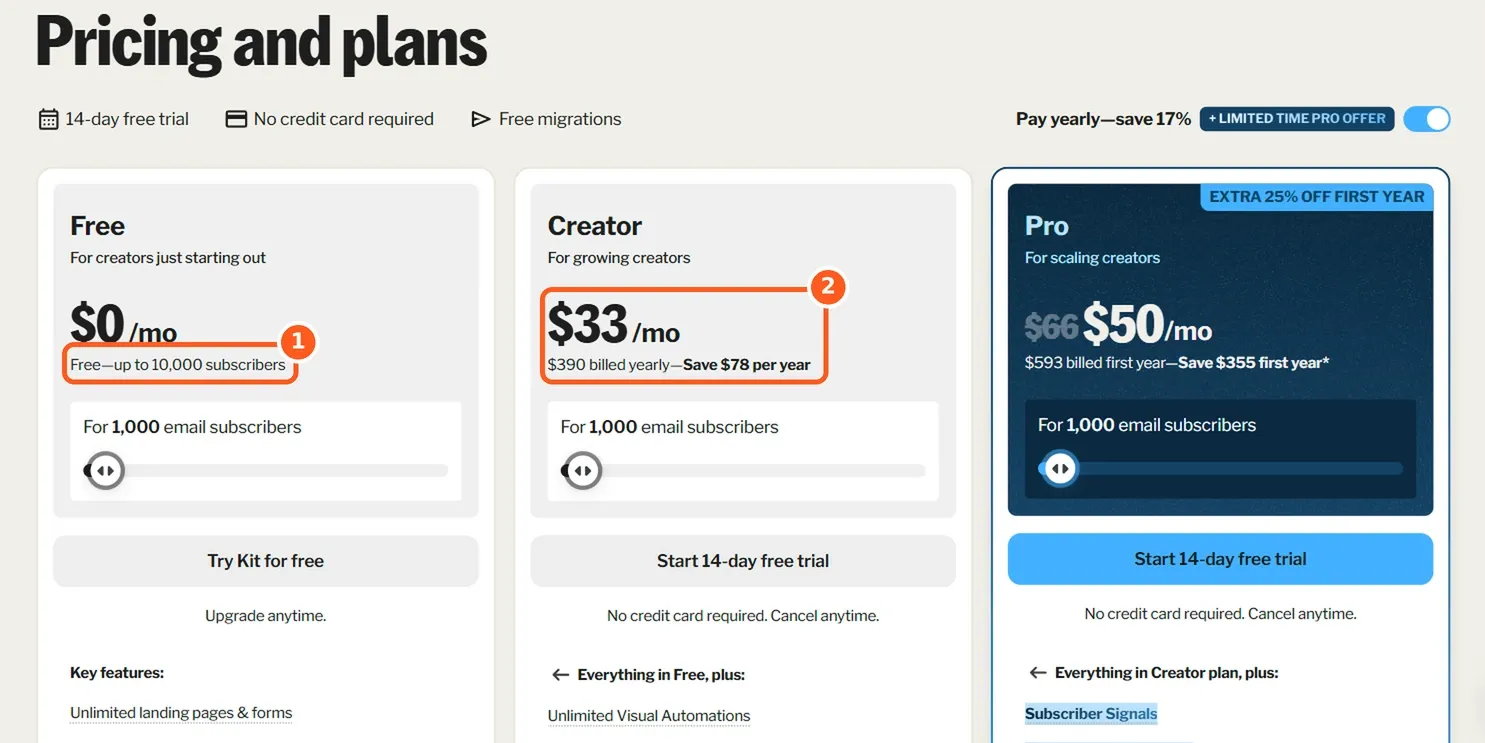
- The price at scale. Kit's free plan stops at 10,000 subscribers, and the Creator plan, which unlocks proper automations, goes from $39 a month at 1,000 subscribers to $139 at 10,000.
- The fee on every sale. Kit charges 3.5% + $0.30 per transaction for paid newsletters and products, on every plan. That includes card processing, so it's only a little more than Stripe's own 2.9% + $0.30. But on an $8 subscription it still works out to about 7% of each payment.
- No real publication. Kit gives you a newsletter feed and landing pages, not a website with an archive, tags, authors and search traffic.
- Generic looks. Kit's pages and templates are tidy but similar. It's hard to make them feel like your brand.
- It's built for marketers. If you only want to write and send, tags, sequences and funnels can feel like overhead.
Kit alternatives compared
| Platform | Free plan | ~1,000 subscribers | ~10,000 subscribers | Cut of paid subscriptions | Real website |
|---|---|---|---|---|---|
| Kit | Up to 10,000 subscribers | $0, or $39 (Creator) | $0 at the limit, or $139 (Creator) | 3.5% + $0.30, card fees included | No, a newsletter feed and landing pages |
| Ghost(Pro) | No (14-day trial); self-hosting is free | $35 (Publisher) | $105 (Publisher) | 0% + Stripe | Yes, any theme or your own design |
| beehiiv | Up to 2,500 subscribers | $0, or $59 (Lite) | $139 (Lite) | 0% + Stripe (paid plans) | Yes, a block-based site builder |
| MailerLite | Up to 250 subscribers | $19 (Comfort) | $89 (Comfort) | 0% + Stripe | Simple sites and landing pages |
| Buttondown | Up to 100 subscribers | $9, +$9 for paid subscriptions | $79, +$9 for paid subscriptions | 0% + Stripe | No, an archive |
| Substack | Free at any size | $0 | $0 | 10% + Stripe | Substack's layout on substack.com |
| Mailchimp | Up to 250 contacts | From $13 (Essentials) for small lists | Around $100 (Standard)* | No built-in paid newsletters | Basic website builder |
"Stripe" means card processing, which every platform passes on: in the US that's 2.9% + $0.30 per payment. Yearly billing is cheaper on most of these: Kit's Creator is $33 a month yearly at 1,000 subscribers, beehiiv's Lite is $49, and Ghost's Publisher is $29. *Mailchimp's price at 10,000 contacts comes from a third-party price tracker; its own page only shows starting prices.
What a paid newsletter really costs
Headline prices don't tell you much if you charge for subscriptions. Here's a newsletter with 10,000 subscribers, 500 of them paying $8 a month ($4,000 a month in revenue). The table shows the platform bill plus fees, on monthly billing.
| Platform | Plan | Platform bill | Fees on 500 payments | Total per month |
|---|---|---|---|---|
| Kit | Free (at its limit) | $0 | About $290 (3.5% + $0.30) | About $290 |
| Kit | Creator, for automations | $139 | About $290 | About $429 |
| Ghost(Pro) | Publisher | $105 | About $266 (Stripe) | About $371 |
| beehiiv | Lite | $139 | About $266 (Stripe) | About $405 |
| Buttondown | Base + paid add-on | $88 | About $266 (Stripe) | About $354 |
| MailerLite | Comfort | $89 | About $266 (Stripe) | About $355 |
| Substack | Free | $0 | $400 (10%) + about $266 (Stripe) | About $666 |
Two honest takeaways. First, Kit's free plan is genuinely competitive for a paid newsletter, because its fee includes card processing. The cost shows up when you need Creator for automations, or when you pass 10,000 subscribers. Second, the gap between the flat-fee platforms is small. The bigger differences are what you get for the money: a real website, growth tools, or a simpler tool.
1. Ghost: best if you want your own publication
Ghost is open-source publishing software with a website, a newsletter and paid memberships built in. It's the biggest change from Kit: instead of an email tool with a feed, you get a full publication on your own domain, with an archive, tags, authors, SEO settings and your own design.
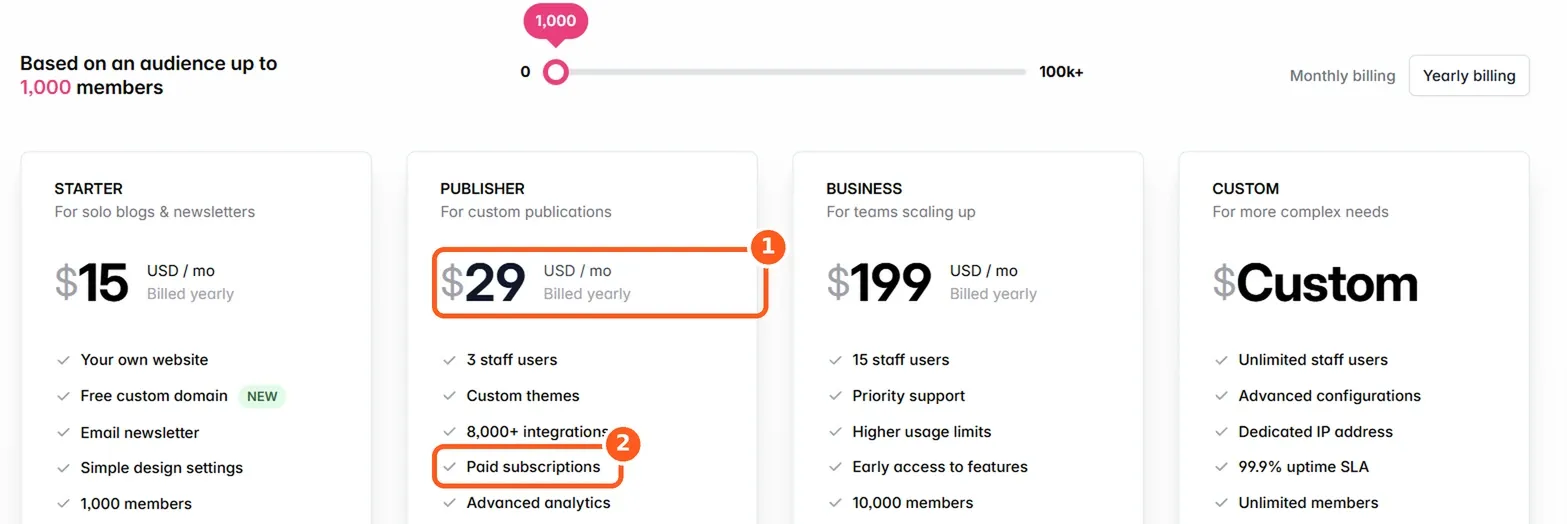
- Price: Ghost(Pro) Publisher, the cheapest plan with paid subscriptions and custom themes, is $35 a month ($29 yearly) for up to 1,000 members, and $105 a month ($88 yearly) at 10,000. Starter is cheaper but has no paid subscriptions and only runs Ghost's official themes. Business is $239 a month ($199 yearly). Self-hosting the software is free; you pay for a server, from about $3 a month (see our cheap Ghost hosting guide).
- Fees: 0% of your revenue. Stripe's fees apply.
- Good: a real website, multiple newsletters, free and paid tiers, members-only comments, recommendations, and Ghost 6's social web support, which lets people follow your publication from Mastodon and other social web apps.
- Less good: automations are basic next to Kit's: a welcome email per tier, not branching sequences. No ad network, no referral program, and no free hosted plan.
- Moving from Kit: subscribers come over by CSV. There's no direct path for Kit paid subscriptions, and broadcasts have to be moved by hand. Our guide covers both: How to migrate from Kit or beehiiv to Ghost.
If you'd rather not run a server, Ghost(Pro) is the easy option: the non-profit Ghost Foundation runs it for you, with updates, backups, a CDN and newsletter sending included. There's a 14-day free trial.
The thing Ghost doesn't solve for you is design. Its themes control how your site looks, and changing one usually means editing code. Ectobuilder lets you build a Ghost theme visually from more than 400 ready-made sections, edit text and pictures right on the page, and publish to Ghost in one click. You can also ask Claude, ChatGPT or Gemini to build or change it for you through its MCP connector. It's free to build; you only pay to publish.
Choose Ghost if you want your newsletter to live on a proper website that looks like you, and you'll charge for it now or later. Skip it if automations are the heart of your business.

Moving your newsletter to Ghost?
Ectobuilder lets you design your Ghost site visually, from a simple newsletter homepage to a full magazine, without touching theme code.
2. beehiiv: best for growth and ad revenue
beehiiv is the closest thing to Kit for people who think about growth all day, but it's aimed at newsletters as media businesses rather than at product funnels. A referral program, Boosts (paid recommendations), an ad network, polls and A/B tests are the core of the product, and a website, podcast hosting and digital products come with every plan.
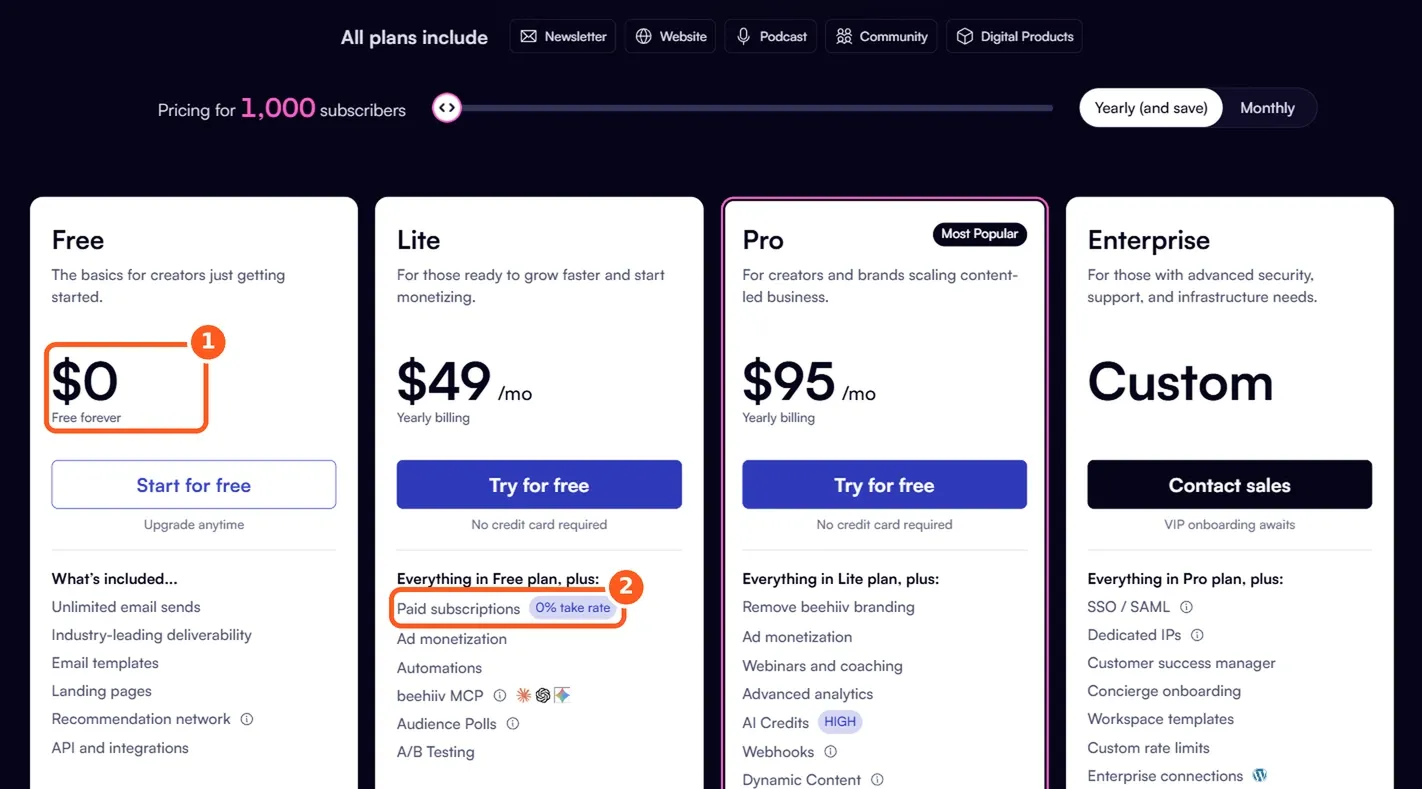
- Price: Free up to 2,500 subscribers. Lite is $59 a month ($49 yearly) at 1,000 subscribers and $139 a month ($119 yearly) at 10,000. Pro, which removes beehiiv branding, is $109 a month ($95 yearly) at 1,000 and $239 ($199 yearly) at 10,000. beehiiv raised its prices for new customers on 1 October 2026.
- Fees: 0% of paid subscriptions and digital products, plus Stripe.
- Good: the strongest growth and monetisation tools here, unlimited sends on every plan, and automations on Lite.
- Less good: paid subscriptions and the ad network need a paid plan, prices climb with list size, and the website builder is less flexible than a real theme system.
- Moving from Kit: beehiiv imports subscribers by CSV and can import public posts from your Kit newsletter site. Paid subscribers only move if your Kit payments ran on a standard Stripe account you control.
Choose beehiiv if sponsorships and growth are your business model. We compare it head to head with Ghost in beehiiv vs Ghost, and with Substack in beehiiv vs Substack.
3. MailerLite: best cheaper Kit for marketers
MailerLite is the most direct Kit replacement if you like what Kit does. It has a drag-and-drop editor, automations, signup forms, landing pages, simple websites and digital products, and it supports paid newsletter subscriptions through Stripe with 0% commission.
- Price: Free up to 250 subscribers and 2,500 emails a month. Comfort was $19 a month at 1,000 subscribers and $89 at 10,000 when we checked; Power, with unlimited sending, $39 and $129. Yearly billing saves 10%.
- Good: automations for much less than Kit's Creator plan.
- Less good: Comfort caps monthly emails at ten times your list size, so a daily newsletter needs Power. It's built for campaigns, not publishing.
Choose MailerLite if you want Kit's toolkit at a lower price and don't need a publication.
4. Buttondown: best for writing-first newsletters
Buttondown is a small, independent tool with a Markdown or rich-text editor, a clean archive and a strong privacy focus. You pay a base price by list size and add only the features you use.
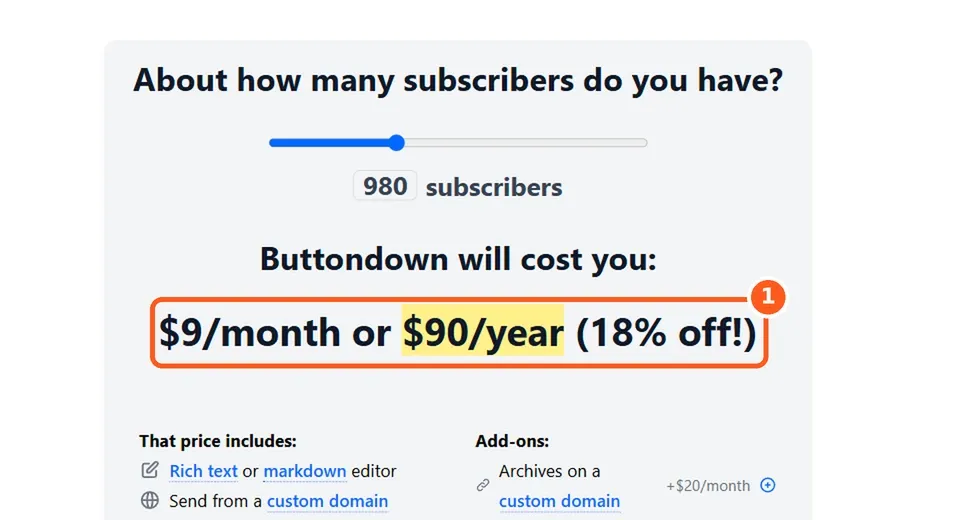
- Price: free for the first 100 subscribers, then $9 a month up to 1,000 and $79 up to 10,000. Paid subscriptions are a $9 add-on; automations, sponsorships and archives on your own domain are $29 add-ons each.
- Fees: 0% of paid subscriptions, plus Stripe.
- Good: cheap, fast and honest. Buttondown says paying subscribers can carry over when both tools use Stripe.
- Less good: add-ons add up, and you get an archive rather than a website.
Choose Buttondown if you mainly want to write and send, for as little as possible.
5. Substack: best for discovery
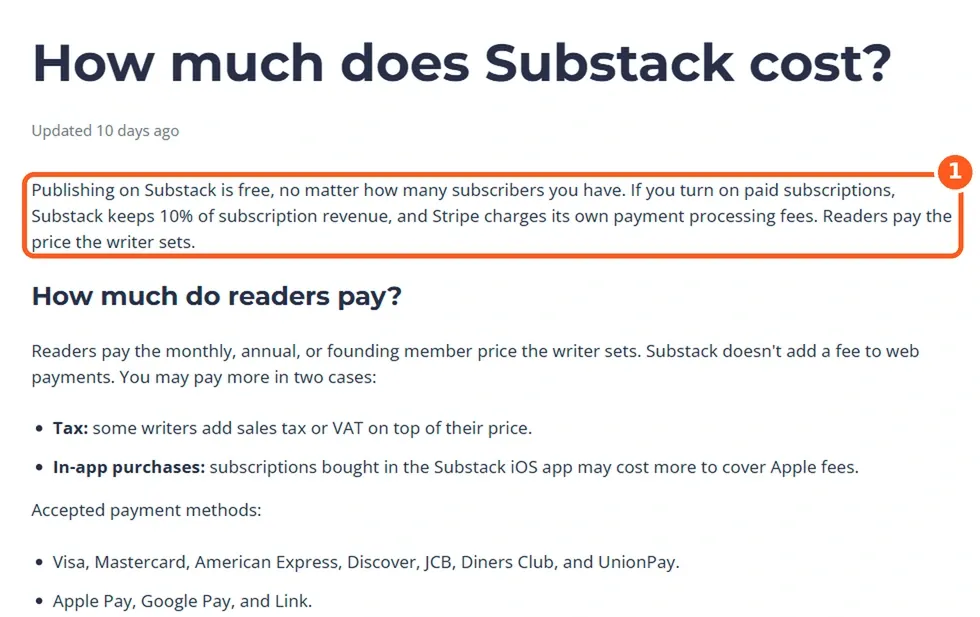
Substack is free at any size and lets you charge from day one. In exchange it keeps 10% of subscription revenue, on top of Stripe's fees. What you get for that is the network: the Substack app, Notes and recommendations put you in front of readers who already pay for newsletters.
- Good: zero setup, zero cost until you earn, real discovery.
- Less good: the 10% grows with you, design is mostly Substack's, and there are no automations to speak of. Coming from Kit, you'd lose most of your marketing tools.
Choose Substack if you want readers more than tools. If you're weighing it against Ghost, see Ghost vs Substack, and our Substack alternatives if you're already there.
6. Mailchimp: best for general business email
Mailchimp is the best-known email marketing tool, built for shops and businesses rather than writers.
- Price: Free up to 250 contacts and 500 emails a month. Essentials starts at $13 a month and Standard at $20 for small lists; Standard is around $100 a month at 10,000 contacts, according to third-party price trackers.
- Good: e-commerce integrations, reporting and a huge template library.
- Less good: no built-in paid newsletter subscriptions, a small free plan, and it gets expensive as your list grows.
Choose Mailchimp if email is one part of a business that sells physical or digital products, not a newsletter you charge for.
7. Stay on Kit, and fix the website
If your automations and sales funnels work, moving may cost you more than it saves. Some creators keep Kit for email and run a Ghost site alongside it for the public archive, SEO and design, connecting the two with Ghost's Kit integration or Zapier. It's more to manage, but it keeps what works.
How to choose
- Is your newsletter a product, or a funnel for one? A funnel: stay on Kit, or try MailerLite. A product: keep reading.
- Do you want a real website? Ghost, and to a lesser extent beehiiv.
- Is growth through ads and referrals the plan? beehiiv.
- Is cost the main thing? Buttondown, or Kit's free plan while you're under 10,000.
- Do you want discovery more than control? Substack.
- Do you have paid subscribers on Kit? Expect to ask them to re-subscribe or give them free access for a while, wherever you go. Our migration guide explains why.
For a wider look at the whole market, see our comparison of the best newsletter platforms.
Picked Ghost? Make it look like yours. Start from a theme in the Ectobuilder gallery or from scratch, add newsletter signups, pricing tables and post lists by clicking, and publish to your Ghost site. Start free and only pay if you're happy with it.
Related: The Newsletter theme: a Substack-style site for Ghost with paid plans and /p/ links.
FAQ
Is Kit the same as ConvertKit?
Yes. ConvertKit renamed itself Kit and moved to kit.com. The product, plans and accounts carried over.
What's the cheapest Kit alternative?
For a free newsletter, beehiiv (free up to 2,500 subscribers) and Substack (free at any size). For a small paid newsletter, Buttondown is the cheapest at about $18 a month with the paid subscriptions add-on. Self-hosted Ghost costs only the server and an email-sending service.
Does Kit take a cut of paid newsletters?
Kit charges 3.5% + $0.30 per transaction on every plan, and that includes card processing. Ghost, beehiiv (on paid plans), Buttondown and MailerLite take 0%, but you pay Stripe's 2.9% + $0.30 separately.
Can I move my paid subscribers off Kit?
Usually not directly. Ghost's own guide says there's no direct path for Kit paid subscriptions, and beehiiv's says the same for Kit accounts on Stripe Express. Most writers give paying readers free access on the new platform until their paid period ends, then ask them to subscribe again.
Is Ghost better than Kit?
For a publication, yes: a real website, your own design, an archive that ranks in search, and 0% of your revenue. For selling courses with automated sequences, no: Kit's automations are far ahead.
Sources
- Kit pricing and Kit Commerce fees
- Ghost(Pro) pricing and Ghost: migrating from Kit
- beehiiv pricing, PPC Land on beehiiv's October 2026 prices and beehiiv: migrating from Kit
- MailerLite pricing and 0% commission on paid newsletters
- Buttondown pricing and Buttondown: migrating from Kit
- Substack: How much does Substack cost?
- Mailchimp pricing and Automation Atlas on Mailchimp prices by list size
Written by
Founder of Ectobuilder, the AI-powered visual theme editor for Ghost. Indie software builder in Wrocław and co-author of The AdTech Book. I write about Ghost themes, newsletters and building websites with AI.
Comments
Questions or thoughts? Share them below.
Keep reading
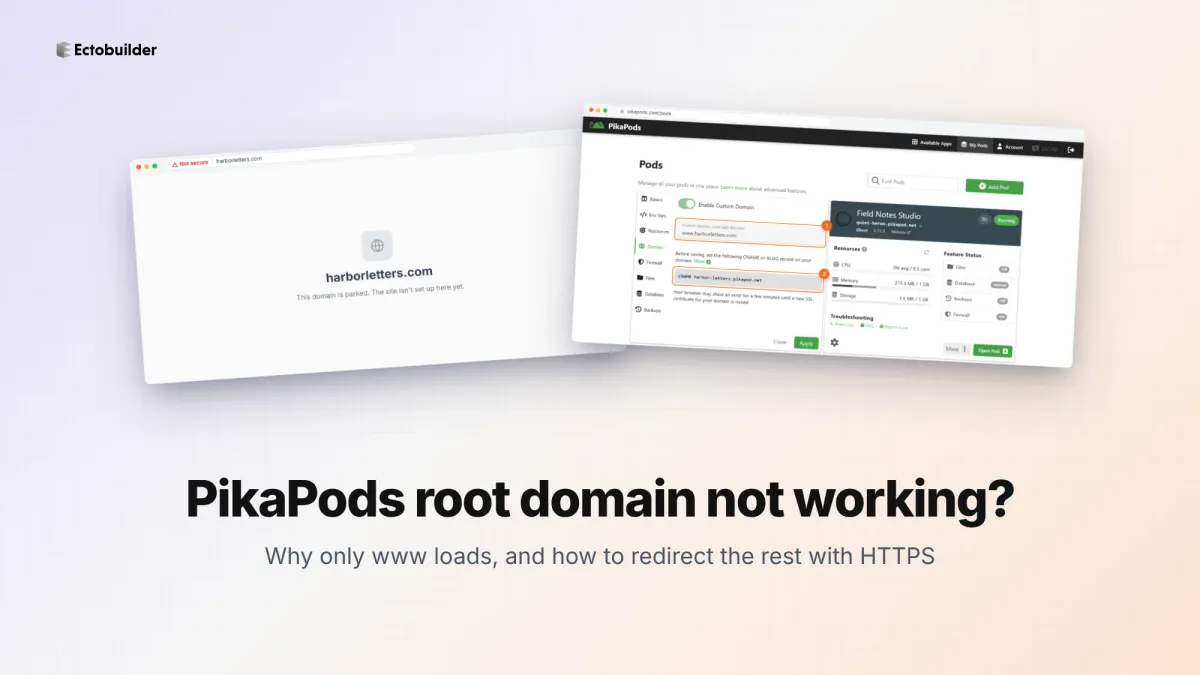
PikaPods Custom Domain: Why Only www Works (and How to Fix the Root Domain)
PikaPods maps one custom domain per pod, so yourdomain.com without www stays on a parked page with no SSL. Here's why, and three ways to redirect it to www over HTTPS without touching your email records.
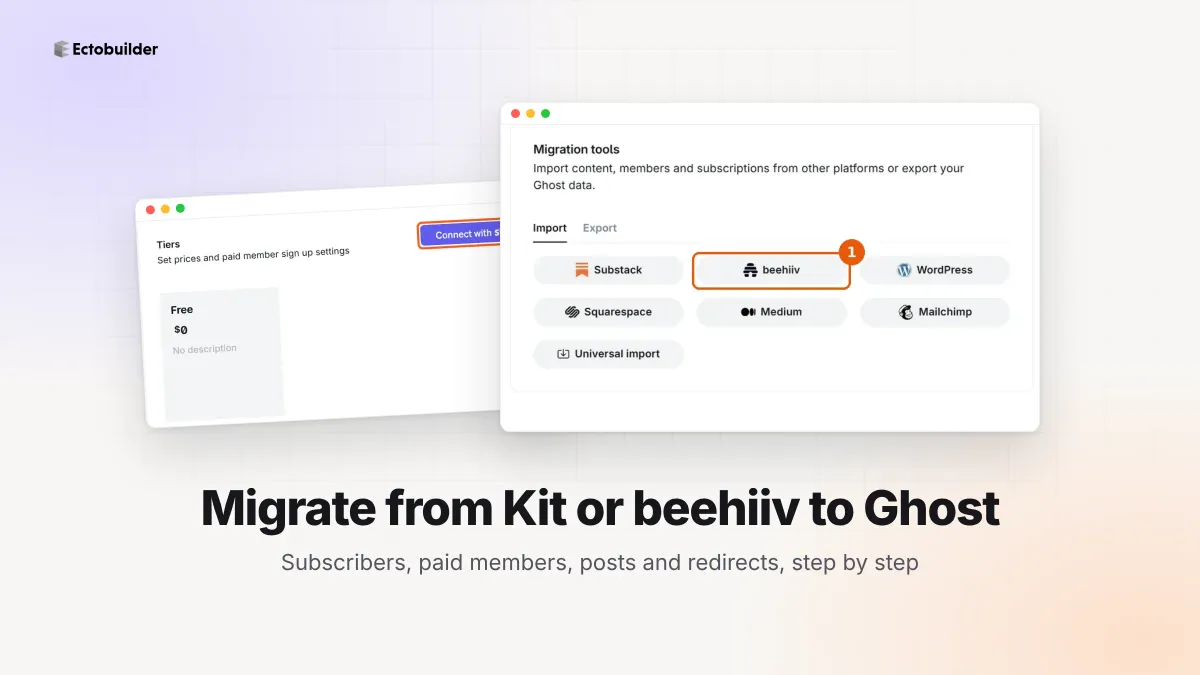
How to Migrate from Kit or beehiiv to Ghost (Subscribers, Paid Members, Posts and Redirects)
Move your newsletter from Kit (ConvertKit) or beehiiv to Ghost step by step: export and import subscribers, deal with paid members and Stripe, bring your posts across, set up redirects and your domain, warm up email sending, and make the new site look right.
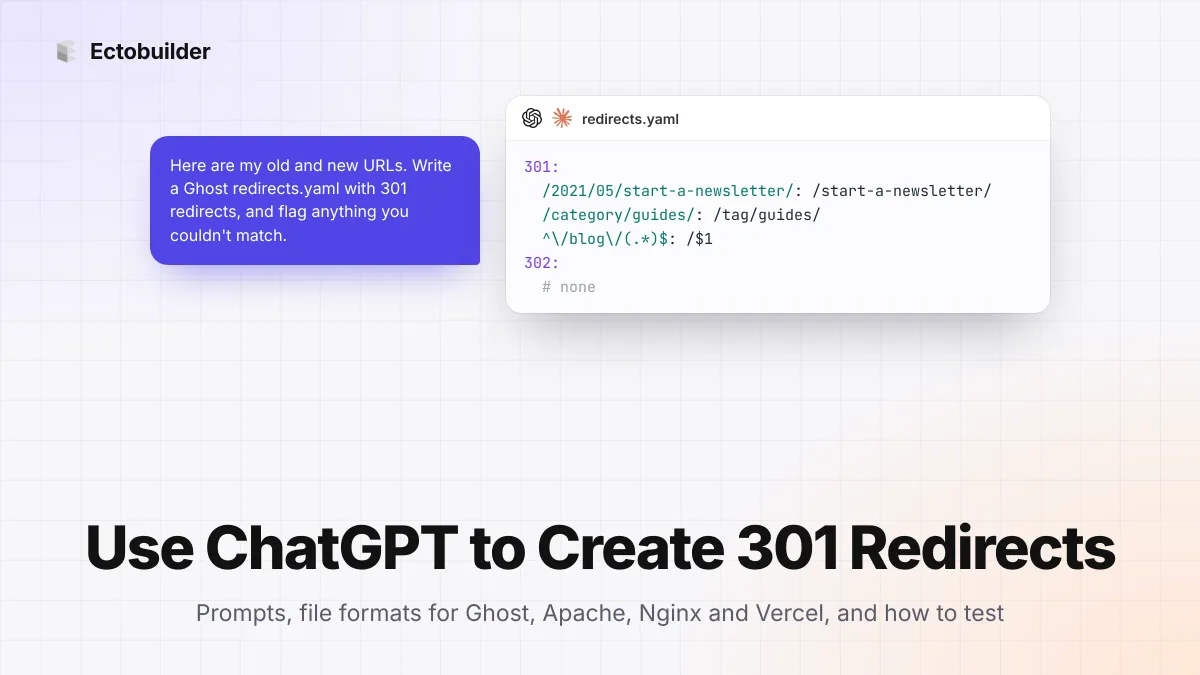
How to Use ChatGPT to Create 301 Redirects (Prompts, File Formats and Testing)
Let ChatGPT or Claude match your old URLs to new ones and write the redirect file for Ghost, Apache, Nginx, Netlify or Vercel. Prompts to copy, the mistakes to avoid, and how to test every redirect.