
Best Newsletter Platforms in 2026: Ghost vs beehiiv vs Kit vs Substack vs Buttondown vs MailerLite
Six newsletter platforms compared on real 2026 prices, what each costs at 1,000 and 10,000 subscribers, the fees and limits to watch for, and which one fits your newsletter.

Michal Wlosik
· 11 min read
Every newsletter platform promises the same thing: write, hit send, grow, get paid. The differences show up later, in the bill at 10,000 subscribers, in the share of your revenue the platform keeps, and in how hard it is to leave. This guide compares the six platforms most people choose between in 2026: Ghost, beehiiv, Kit, Substack, Buttondown and MailerLite.
All prices were checked on each platform's pricing page on 13 October 2026, in US dollars, before tax.
The short answer
- Ghost if you want a full website and a newsletter in one, with 0% revenue cut and software you can take anywhere.
- beehiiv if you want to grow fast and earn from ads and sponsorships as well as subscriptions.
- Kit if you sell courses, products or coaching and the newsletter is your sales engine.
- Substack if you want to start free today and be discovered inside an app, and you accept giving up 10%.
- Buttondown if you want a simple, fast, privacy-friendly tool that bills you only for what you use.
- MailerLite if you need a low-cost email marketing tool for a business, with forms, automations and landing pages.
The six platforms at a glance
| Free plan | Paid plans from | Cut of paid subscriptions | Best for | |
|---|---|---|---|---|
| Ghost(Pro) | No (14-day trial); self-hosting is free | $18/mo ($15 yearly) | 0% | Publications that want a real website |
| beehiiv | Up to 2,500 subscribers | $59/mo ($49 yearly) | 0% | Growth, ads and sponsorships |
| Kit | Up to 10,000 subscribers | $39/mo ($33 yearly) | 3.5% + $0.30 per sale | Creators selling products |
| Substack | Free at any size | None | 10% | Writers who want discovery |
| Buttondown | Up to 100 subscribers | $9/mo | 0% | Minimalists and developers |
| MailerLite | Up to 250 subscribers | $19/mo | 0% | Small business email marketing |
Card processing fees from Stripe apply on every platform that takes payments, so they're left out of the comparisons below unless a platform charges its own fee on top.
What it really costs: three typical newsletters
Headline prices are for 1,000 subscribers. Most platforms charge more as your list grows, and some keep a share of what you earn. Here's what each one costs per month, on monthly billing, for three common situations. Paying yearly saves between 10% and 20% on most of them.
| 1,000 subscribers, free newsletter | 1,000 subscribers, 100 paying $8 ($800/mo) | 10,000 subscribers, 500 paying $8 ($4,000/mo) | |
|---|---|---|---|
| Ghost(Pro) | $18 (Starter) | $35 (Publisher) | $105 (Publisher) |
| beehiiv | $0 (Free) | $59 (Lite) | $139 (Lite) |
| Kit | $0 (Free) | About $58 in sales fees (Free) | About $290 in sales fees (Free, at its 10,000 limit) |
| Substack | $0 | $80 (10%) | $400 (10%) |
| Buttondown | $9 | $18 ($9 + paid subscriptions add-on) | $88 ($79 + add-on) |
| MailerLite | $19 (Comfort) | $19 (Comfort) | $89 (Comfort) |
Three things stand out. For a free newsletter, beehiiv, Kit and Substack cost nothing. Once you charge for subscriptions, the flat-fee platforms pull ahead, and the gap widens as revenue grows: at $4,000 a month, Substack keeps $400 while Ghost, beehiiv, Buttondown and MailerLite cost about $90 to $140. Kit's free plan looks free but its per-sale fee adds up, and it ends at exactly 10,000 subscribers.

Running your newsletter on Ghost? Ectobuilder lets you design the website around it visually, from a simple newsletter homepage to a full magazine, without touching theme code.
Ghost: a newsletter with a real website
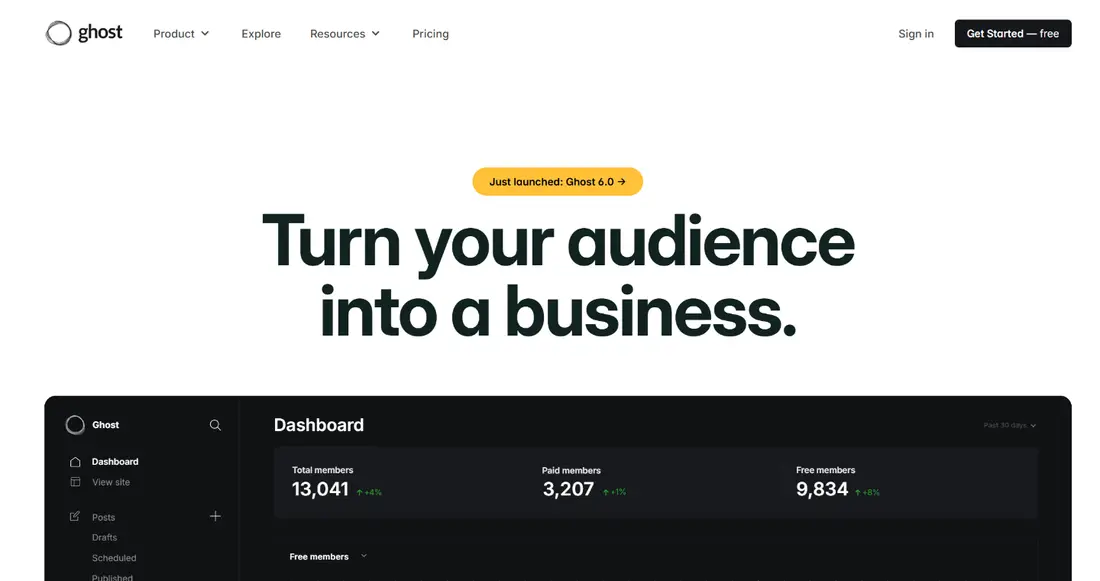
Ghost is an open-source publishing platform: a website, a blog, a newsletter and paid memberships in one. You can pay Ghost to host it (Ghost(Pro)) or run the same software anywhere else, which makes it the only platform here you can fully take with you.
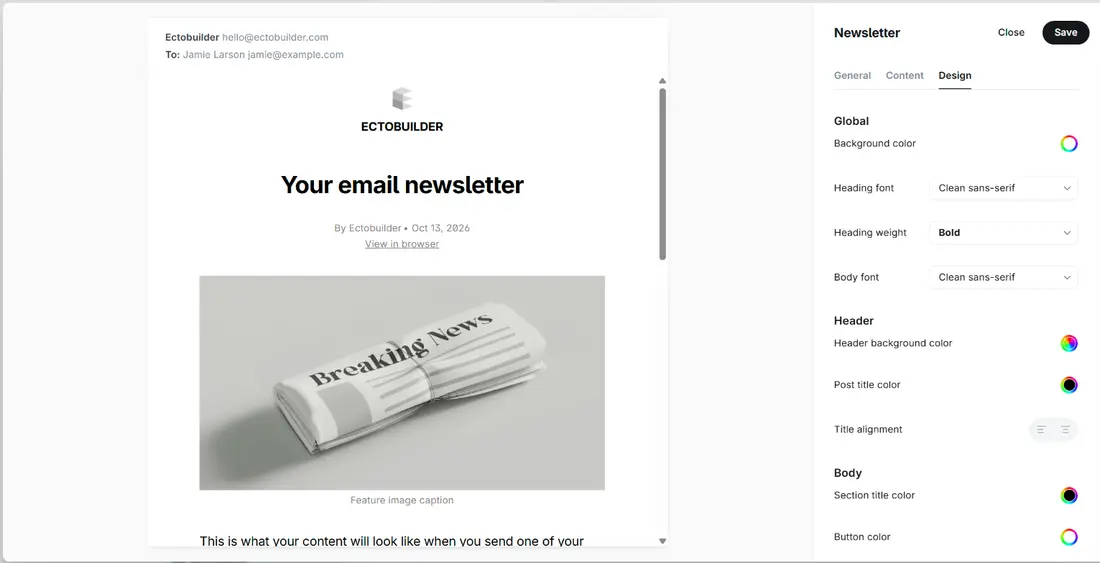
If you’d rather not run a server, Ghost(Pro) is the easy option: the Ghost Foundation runs it for you, with updates, backups, a CDN, built-in analytics and newsletter sending included, and 0% taken from your paid subscriptions. Your subscription also funds Ghost’s development. Pick Publisher if you want a custom theme; Starter only runs Ghost’s official ones. There’s a 14-day free trial.
Pricing. Starter costs $18/month ($15 yearly) for up to 1,000 members, with one staff user and Ghost's own themes. Publisher, from $35/month ($29 yearly), adds paid subscriptions, custom themes and three staff users, and rises to $105/month ($88 yearly) at 10,000 members. Business is $239/month ($199 yearly). Ghost takes 0% of what you earn on every plan.
Watch for:
- Starter has no paid subscriptions and no custom themes. Most newsletters that want to earn need Publisher.
- Members, not just email subscribers, count toward your plan, and the price steps up as you grow.
- Self-hosting is cheaper (from about $3 a month, see our cheap Ghost hosting guide), but you have to set up bulk email through Mailgun yourself.
- Ghost has no ad network and no built-in referral program.
Best for: writers, journalists and small publications that want their newsletter to live on a proper website with their own design, SEO and archive, and want to keep all their subscription revenue.
Ghost's themes control how your site looks. You can pick one from the Ghost marketplace, or design your own visually with Ectobuilder: choose sections like a newsletter signup hero, post lists and pricing tables, change them by clicking, and publish straight to your Ghost site.
beehiiv: built for growth and ad revenue
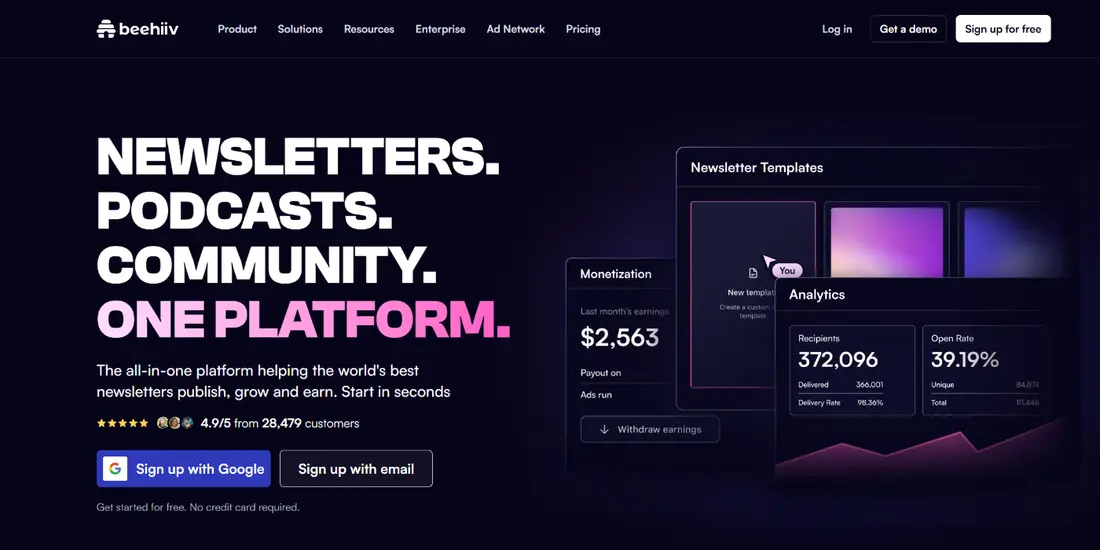
beehiiv was built by former Morning Brew staff and it shows: everything is aimed at growing a list and making money from it. A referral program, a recommendation network, paid recommendations, polls, A/B tests and its own ad network are all built in, along with a website builder, podcast hosting and digital products.
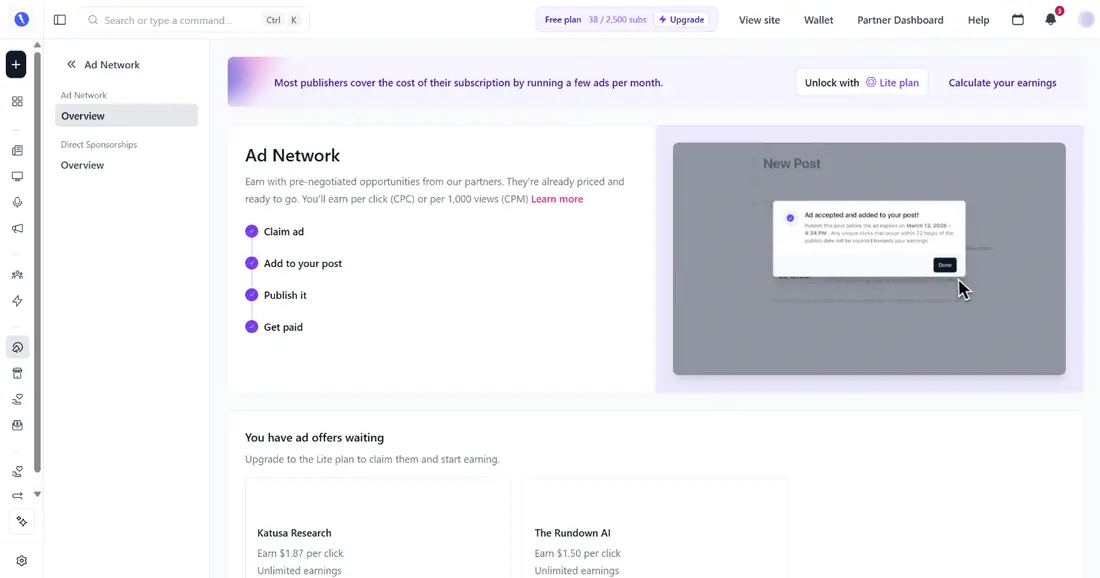
Pricing. Free covers up to 2,500 subscribers with unlimited sends. Lite, from $59/month ($49 yearly) at 1,000 subscribers, adds paid subscriptions with a 0% take rate, automations and the ad network; it's $139/month at 10,000. Pro, from $109/month ($95 yearly), adds removal of beehiiv branding, advanced analytics and webhooks.
Watch for:
- The Free plan stops at 2,500 subscribers, and a free newsletter above that needs a paid plan.
- Removing beehiiv branding needs Pro, not Lite.
- beehiiv renamed and repriced its plans in October 2026, and prices climb quickly with list size. Check the calculator for your own numbers.
- The website builder is good for a newsletter site but less flexible than a full CMS.
Best for: newsletters run as a business, especially ones that plan to earn from sponsors rather than (or as well as) a paywall. Many publishers cover the plan with a few ads a month. Read our full beehiiv vs Substack comparison.
Want 20% off beehiiv?
New users get 20% off their first 3 months of a paid plan through our link, after the free trial. It's an affiliate link: we may earn a commission, at no extra cost to you.
Kit: email marketing for creators who sell
Kit (formerly ConvertKit) is email marketing software for creators: tagging and segments, visual automations, landing pages and forms, plus a commerce feature for selling digital products and paid newsletters. It's less a publication than a sales funnel, and it's very good at that.
Pricing. Free covers up to 10,000 subscribers with unlimited broadcasts and landing pages, but only one basic automation. Creator costs $39/month ($33 yearly) at 1,000 subscribers and $139/month at 10,000, and adds unlimited automations and sequences and removes Kit branding. Pro costs $79/month ($66 yearly) at 1,000 and $189/month at 10,000.
Watch for:
- Kit charges 3.5% + $0.30 on every sale through Kit Commerce, on every plan. On an $8 monthly subscription that's about 7%.
- There's no real website or archive: your newsletter lives in inboxes and on landing pages.
- The free plan's single automation means no welcome sequence worth the name until you upgrade.
Best for: coaches, course creators and authors who use email to sell, and who need automations and segments more than a publication-style website.
Substack: free to start, 10% when you earn
Substack is free at any size and you can turn on paid subscriptions on day one. In exchange, it keeps 10% of subscription revenue, on top of Stripe's fees. Its biggest advantage is the network: the Substack app, Notes and recommendations put your writing in front of readers who already pay for newsletters.
Watch for:
- The 10% grows with your success. At $4,000 a month in subscriptions, that's $4,800 a year.
- Readers who subscribe through Apple in the Substack iOS app can't be moved with you if you leave.
- Design is mostly Substack's: colours, a logo and a few layout options. A custom domain costs a one-time $50.
- There are no ads, automations or segments to speak of.
Best for: writers starting from zero who want discovery and no upfront cost. If you outgrow it, see our Substack alternatives, Ghost vs Substack and how to move from Substack to Ghost.
Buttondown: small, fast and fair
Buttondown is a small, independent newsletter tool with a Markdown or rich-text editor, a hosted archive, a custom sending domain on every plan, and a strong focus on privacy. It's popular with developers and writers who want a tool that stays out of the way.
Pricing. Free for the first 100 subscribers. Then $9/month up to 1,000, $29/month up to 5,000 and $79/month up to 10,000, with about 18% off yearly. Extras such as paid subscriptions, analytics, tagging and RSS-to-email are add-ons at $9/month each. Buttondown takes no cut of paid subscriptions.
Watch for:
- Add-ons add up: a paid newsletter with analytics and tagging costs $27/month more than the base price.
- The archive is simple, and there's no growth network or ad marketplace.
Best for: personal and technical newsletters, and anyone who prefers paying for exactly what they use.
MailerLite: affordable email marketing
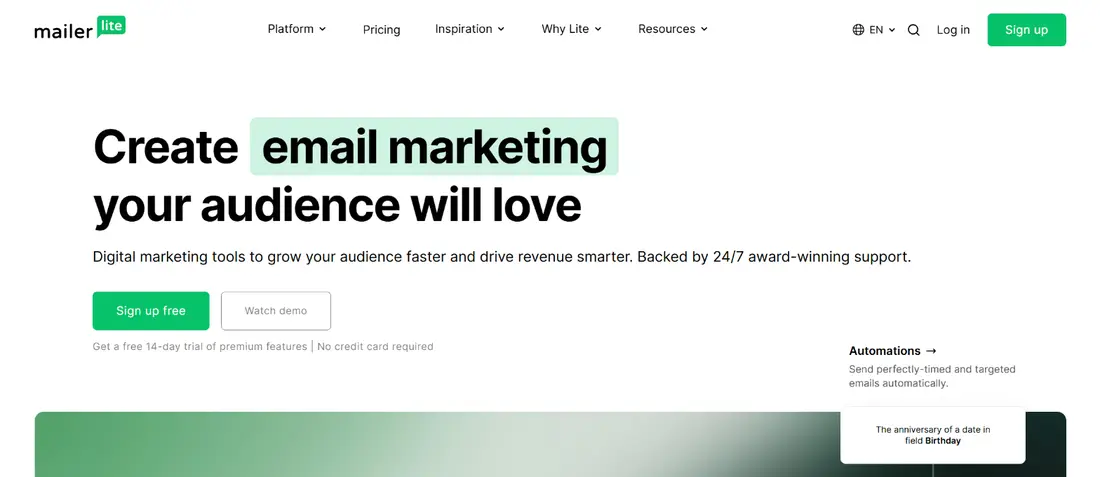
MailerLite is an email marketing platform for small businesses: a drag-and-drop editor, automations, signup forms, landing pages, simple websites and digital products. It also supports paid newsletter subscriptions through Stripe and takes 0% commission on them.
Pricing. The free plan has shrunk to 250 subscribers and 2,500 emails a month. Comfort costs $19/month at 1,000 subscribers (10,000 emails a month) and $89/month at 10,000. Power, with unlimited sending, automations and seats, costs $39/month at 1,000 and $129/month at 10,000. Yearly billing saves 10%.
Watch for:
- Comfort caps monthly emails at ten times your list size, so a daily newsletter needs Power.
- It's built for marketing campaigns rather than publishing: there's no reader network and the archive is basic.
Best for: shops, service businesses and freelancers who want newsletters plus marketing automation at a low price.
What to watch for, whichever you choose
- Who owns the list. Every platform here lets you export subscribers as a CSV. Paid subscribers are a different matter: they move only if your Stripe account comes with you. Ghost, beehiiv and Buttondown connect your own Stripe account; Substack's iOS in-app subscriptions can't be moved at all.
- Percentage fees vs flat fees. A 10% cut is cheap when you earn little and expensive when you earn a lot. Work out the break-even for your own numbers before you pick.
- Price jumps by list size. The jump from 1,000 to 10,000 subscribers is usually three times or more. Check the calculator at the size you expect to reach in a year, not the size you are today.
- Website or inbox. If search traffic, an archive and your own design matter, you need a platform with a real website (Ghost, and to a lesser extent beehiiv). If your readers live in their inbox, any of them will do.
- Branding. Free plans add the platform's logo to your emails. Removing it needs a paid plan, and on beehiiv the top one.
- Deliverability. All six handle sending for you, with one exception: self-hosted Ghost needs a Mailgun account for newsletters.
Which should you choose?
- Starting from zero, no budget, writing first: Substack, or beehiiv's Free plan if you'd rather own your setup from day one.
- Planning to earn from sponsors and ads: beehiiv.
- Selling courses, coaching or products: Kit.
- Paid newsletter earning more than a few hundred dollars a month: Ghost, beehiiv or Buttondown, all with 0% cut.
- Want a real website, SEO and your own design, and to keep everything portable: Ghost.
- Small business that needs email marketing more than a publication: MailerLite.
- Personal or technical newsletter, simple and cheap: Buttondown.
Picked Ghost? Make it look like yours. Start from a theme in the Ectobuilder gallery or from scratch, add newsletter signups, pricing tables and post lists by clicking, and publish to your Ghost site. Start free and only pay if you're happy with it.
FAQ
What is the cheapest newsletter platform?
For a free newsletter, Substack (free at any size), Kit (free up to 10,000 subscribers) and beehiiv (free up to 2,500). For a paid newsletter, the flat-fee platforms with a 0% cut, Buttondown, MailerLite, Ghost and beehiiv, usually cost the least once you earn a few hundred dollars a month. Self-hosted Ghost is cheapest of all if you're comfortable setting it up.
Which newsletter platforms don't take a cut of subscriptions?
Ghost, beehiiv (on Lite and Pro), Buttondown and MailerLite take 0%. Substack keeps 10%, and Kit charges 3.5% + $0.30 per sale. Stripe's card fees apply on all of them.
Is beehiiv better than Substack?
For growth tools, ads and keeping your revenue, yes. For discovery and starting free at any size, Substack is stronger. Our beehiiv vs Substack comparison goes through it in detail.
Can I switch newsletter platforms later?
Yes. Free subscribers move as a CSV export, and Ghost and beehiiv both import posts from Substack. Paid subscribers move with your Stripe account. Plan for some loss: app followers, comments and engagement history usually stay behind.
Do I need a website for my newsletter?
Not to start. But a website with a searchable archive brings in readers from Google and AI search, and gives new visitors somewhere to subscribe. Ghost is built around one; beehiiv and Substack include simpler ones.
Sources
- Ghost(Pro) pricing
- beehiiv pricing
- Kit pricing
- Substack: How much does Substack cost?
- Buttondown pricing and paid subscriptions
- MailerLite pricing and 0% commission on paid subscriptions
- Screenshots of beehiiv and Ghost Admin taken in live accounts, 13 October 2026
Written by
Founder of Ectobuilder, the AI-powered visual theme editor for Ghost. Indie software builder in Wrocław and co-author of The AdTech Book. I write about Ghost themes, newsletters and building websites with AI.
Comments
Questions or thoughts? Share them below.
Keep reading
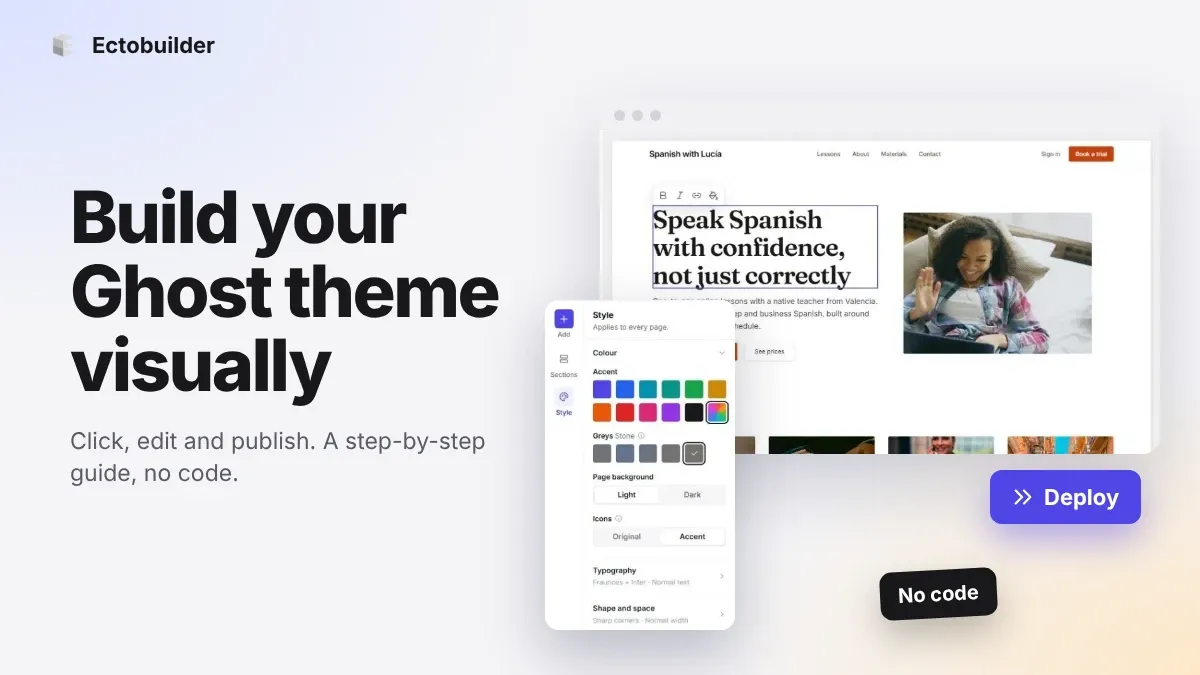
How to Build Your Ghost Theme Visually (Step-by-Step Guide, No Code)
Build a complete Ghost theme without touching code: start from a theme, edit text and pictures in place, add sections from a library of 270, set colours and fonts, design every page, and publish to Ghost in one click. Step by step, with screenshots.
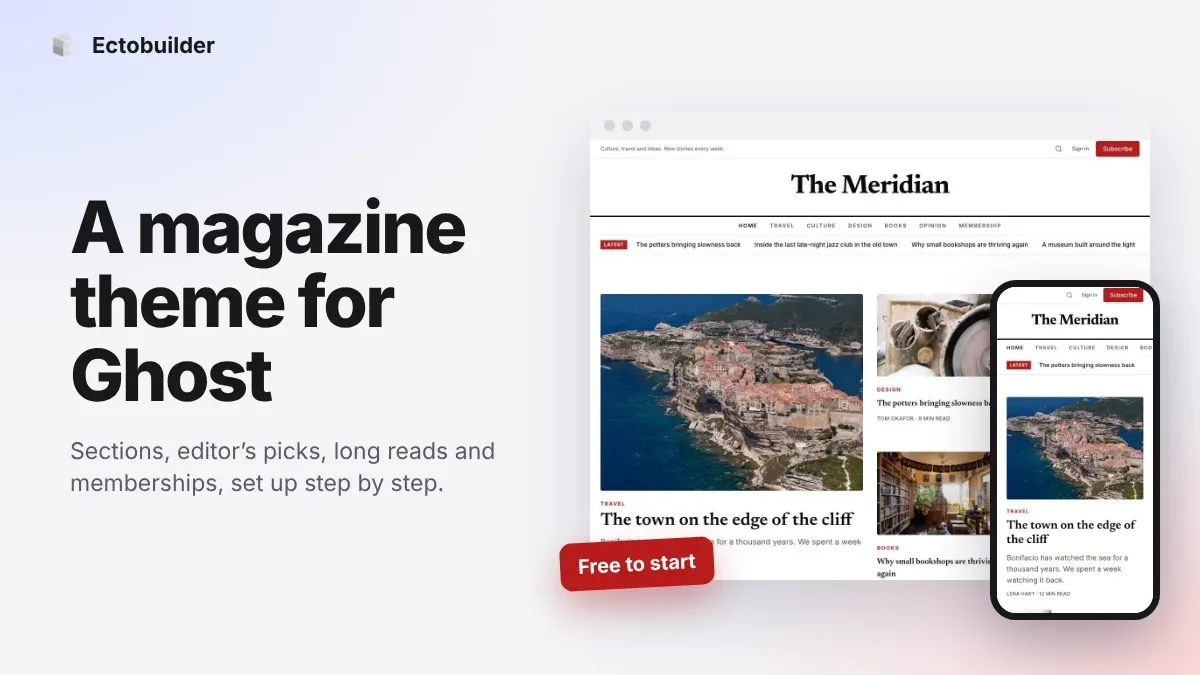
Magazine Theme for Ghost: Sections, Editor's Picks, Long Reads and Memberships
A step-by-step guide to the Magazine theme for Ghost: turn sections into tags, set up the navigation, fill the front page, editor's picks and section fronts, add your writers, sell memberships and send a weekly newsletter.
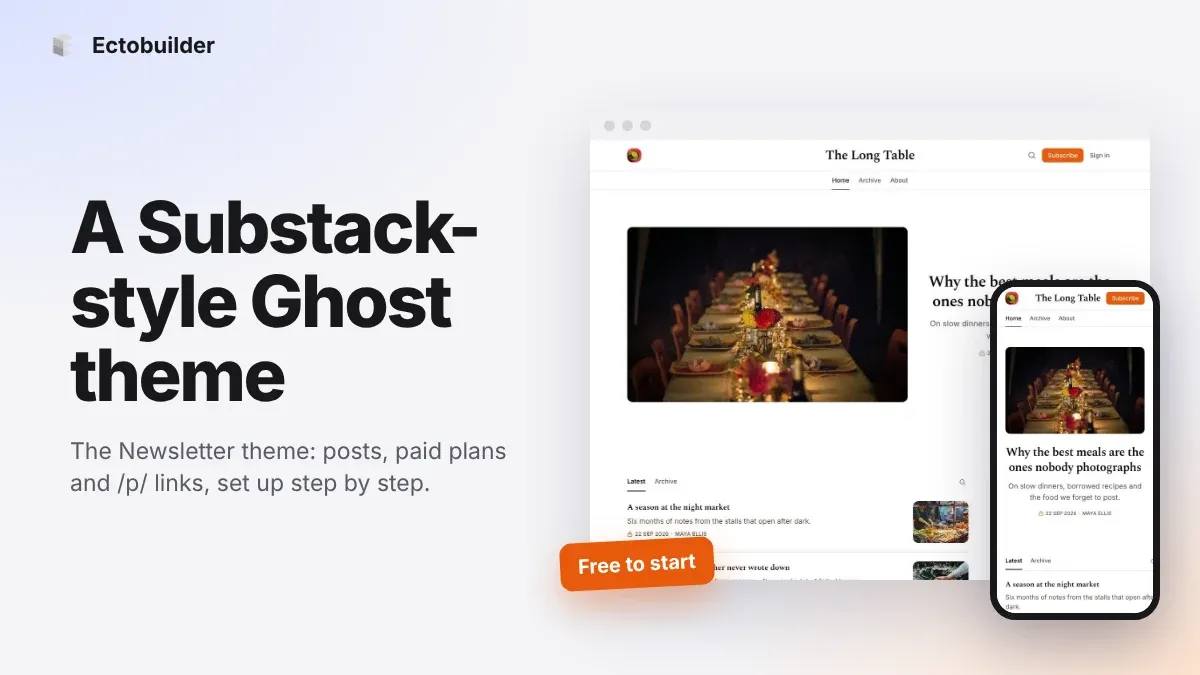
Newsletter Theme for Ghost: A Substack-Style Site With Paid Plans, /p/ Links and Comments
A step-by-step guide to the Newsletter theme for Ghost: a Substack-style homepage and reading page, then newsletters, paid plans, /p/ addresses, Plans, Welcome and About pages, comments and recommendations.