
Copyfolio Alternatives: 7 Portfolio Platforms for Writers Compared (2026)
Copyfolio, Ectobuilder with Ghost, Journo Portfolio, Authory, Muck Rack, Carrd and Squarespace compared on features and what they really cost per year, with a recommendation for each kind of writer.

Michal Wlosik
· 8 min read
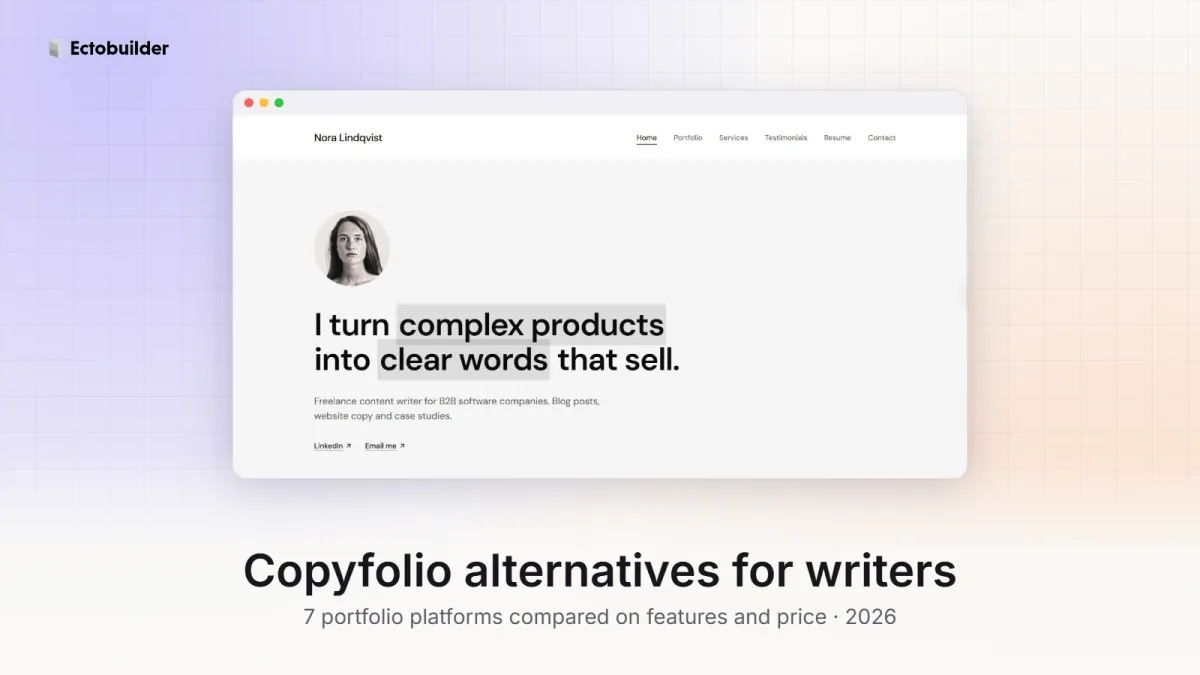
A writing portfolio has one job: get a client or editor from "who is this?" to "let's talk" in a couple of minutes. Copyfolio is built for exactly that, and it's a good tool. But it's not the only option, and depending on what you write and how much you want to spend, something else may suit you better.
Here are seven platforms writers use for their portfolios, what each is good at, and what each costs over a year.
Quick comparison
| Platform | Best for | Cheapest plan with your own domain | Blog and newsletter |
|---|---|---|---|
| Copyfolio | Copywriters who want guidance | $108/yr | Blog, no newsletter |
| Ghost + Ectobuilder | Writers who want a portfolio, blog and newsletter they own | about $30/yr hosting + $79 theme in year one | Both, built in |
| Journo Portfolio | Journalists and freelancers on a budget | $120/yr | Blog |
| Authory | Prolific writers with lots of bylines | $180/yr | Newsletter of your new articles |
| Muck Rack | Journalists who want to be found by PR people | Free (no custom domain) | No |
| Carrd | A one-page portfolio for almost nothing | $19/yr | No |
| Squarespace | Writers who also want a shop or bookings | $228/yr | Blog; newsletter costs extra |
Domains cost extra on most platforms, usually $10 to $20 a year. Prices are for yearly billing, in US dollars, as of October 2026.
1. Copyfolio
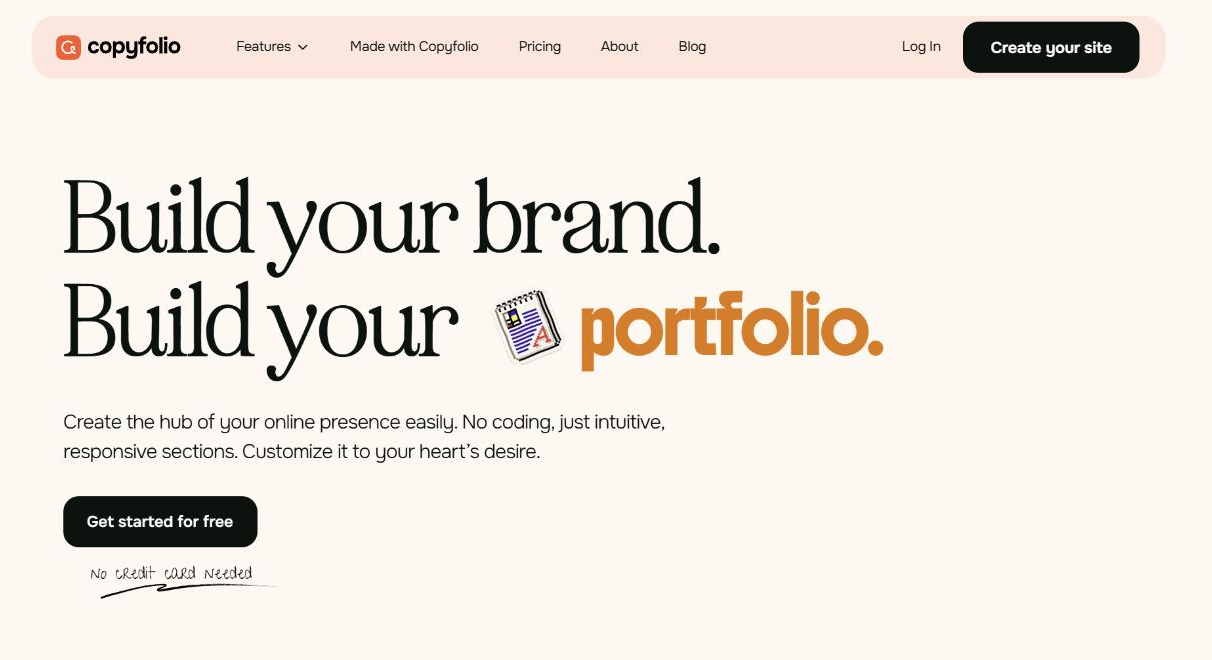
Copyfolio is a portfolio builder made specifically for copywriters and content writers. Instead of a blank page, it walks you through the pieces a writer's portfolio needs: an intro, your services, your work, testimonials, your process and a way to get in touch.
What you get:
- Ready-made page types for a writer's site: home, portfolio, services, testimonials, resume, process and contact, plus case study pages for individual projects.
- Portfolio projects that can link to published work, hold a PDF, or be a full case study page, grouped into categories.
- A simple blog.
- Design presets with fonts and colours you can adjust, and branding help built into the editor.
- A custom domain, SEO settings, Google Analytics, a cookie banner and password protection.
- A contact form that emails you.
Pricing: Premium is $15 a month or $108 a year. The free tier lets you build and try it out, but you need Premium to publish.
Watch out for: Copyfolio has no export. If you leave, you copy your content out by hand. There's no newsletter, and the blog is basic.
Choose it if you're a copywriter starting out, you want to be guided through what to put on your site, and $108 a year is fine.
2. Ghost + Ectobuilder
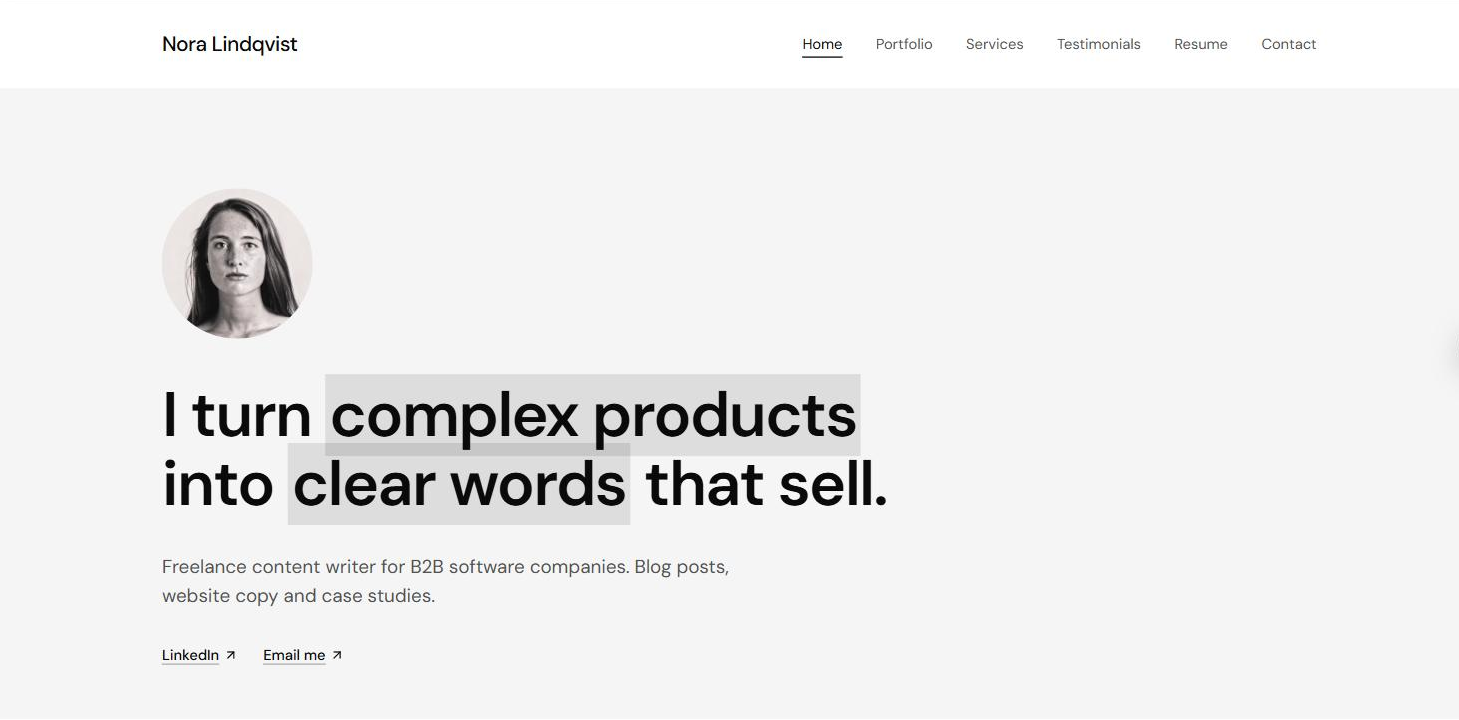
Ghost is open-source publishing software used by independent writers and newsrooms. It gives you pages, a proper blog and a newsletter with free and paid subscriptions, all in one place. What it doesn't give you out of the box is a portfolio design.
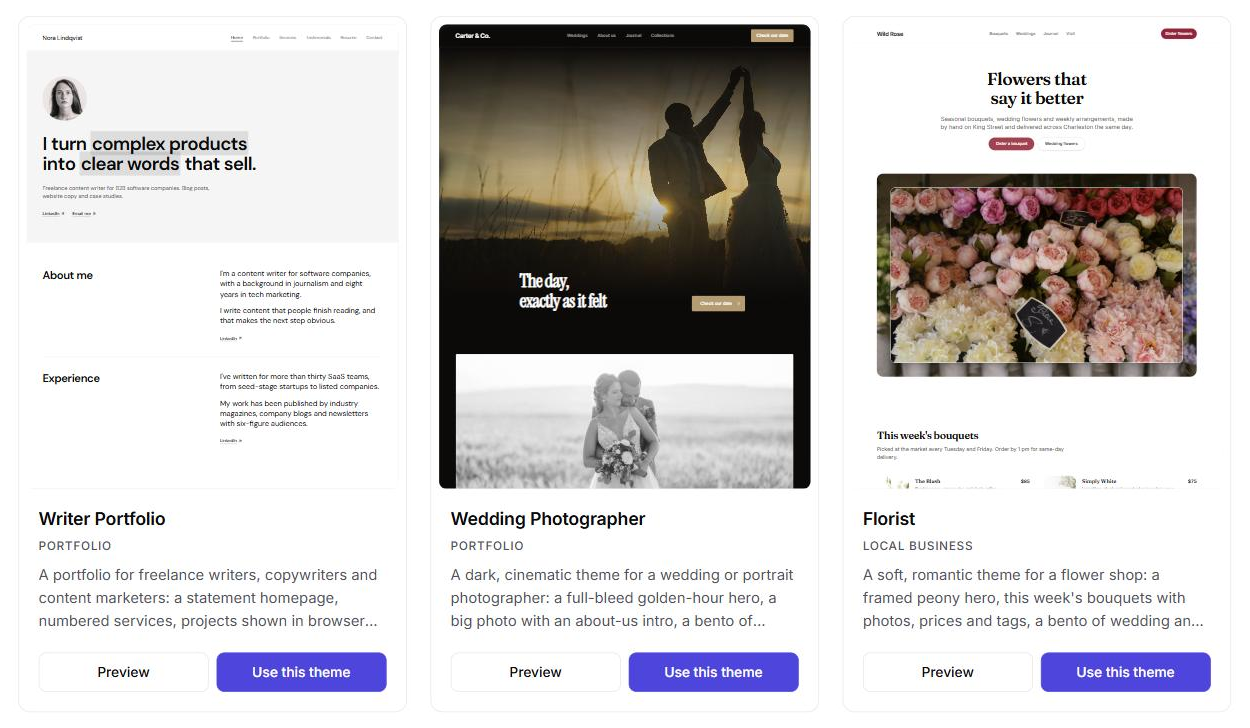
That's what Ectobuilder adds. It's a visual theme builder for Ghost, and its Writer Portfolio theme has the same kinds of pages a Copyfolio site has: an intro with highlighted words, services, numbered portfolio categories with project rows, testimonials, a resume, a process page with FAQ, and a contact form. Case studies can be Ghost posts that appear on your portfolio page automatically. You change text and images on the canvas, no code. Readers can also click to enlarge your pictures.
What you get:
- All the portfolio sections above, plus about 270 more for other pages.
- A full blog, and a newsletter you can send to subscribers, with paid subscriptions if you want them.
- Your own data: Ghost exports everything as a file, and you can move hosts any time.
- Addresses that match Copyfolio's (
yourname.com/portfolio), so switching doesn't break your links.
Pricing: Ghost itself is free; you pay for hosting. On PikaPods it's about $30 to $40 a year; fully managed hosts like Magic Pages are €130 a year. Building with Ectobuilder is free; publishing a theme needs Pro ($79 a year) or Lifetime ($199 once). The theme keeps working if you stop paying. So year one costs about the same as Copyfolio, and later years far less.
If you’d rather not run a server, Ghost(Pro) is the easy option: the Ghost Foundation runs it for you, with updates, backups, a CDN, built-in analytics and newsletter sending included, and 0% taken from your paid subscriptions. Your subscription also funds Ghost’s development. Pick Publisher if you want a custom theme; Starter only runs Ghost’s official ones. There’s a 14-day free trial.
Setting up PikaPods for the first time? Follow How to host Ghost on PikaPods.
Watch out for: Setup takes longer than an all-in-one builder: you create a Ghost site, then publish the theme to it. On the cheapest hosting, sending newsletters needs a Mailgun account.
Choose it if you want a portfolio, a blog and a newsletter in one place, and you'd rather own your site than rent it. Moving from Copyfolio? Follow How to migrate from Copyfolio to Ghost (and keep your links).

Skip the setup. The Writer Portfolio theme already has a statement homepage, services, projects, a resume and a contact form. Open it in Ectobuilder, swap in your words and photos, and only pay if you’re happy with the design.
3. Journo Portfolio
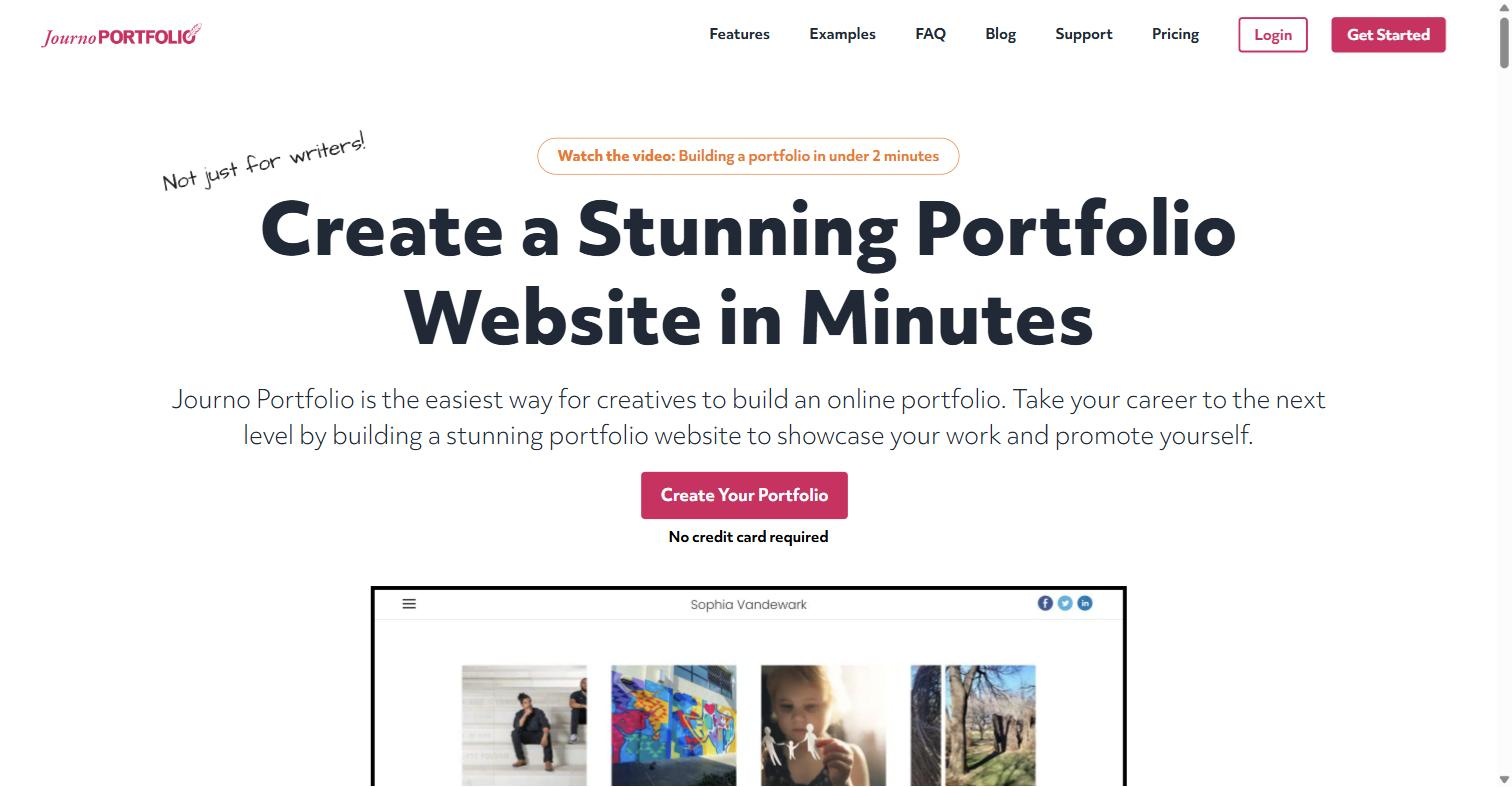
Journo Portfolio started as a portfolio site for journalists and now serves writers of all kinds. You pick a theme, add your articles (it can pull in the title, image and summary from a link), and arrange them on pages.
Pricing: Plus is $7 a month on yearly billing ($84 a year) but doesn't include a custom domain. Pro, with your own domain, is $10 a month yearly ($120 a year). Unlimited is $14 a month yearly. The free plan lets you build but not publish.
Choose it if most of your work is published articles you want to show as a clean grid of clippings, and you want to be set up in an hour.
4. Authory
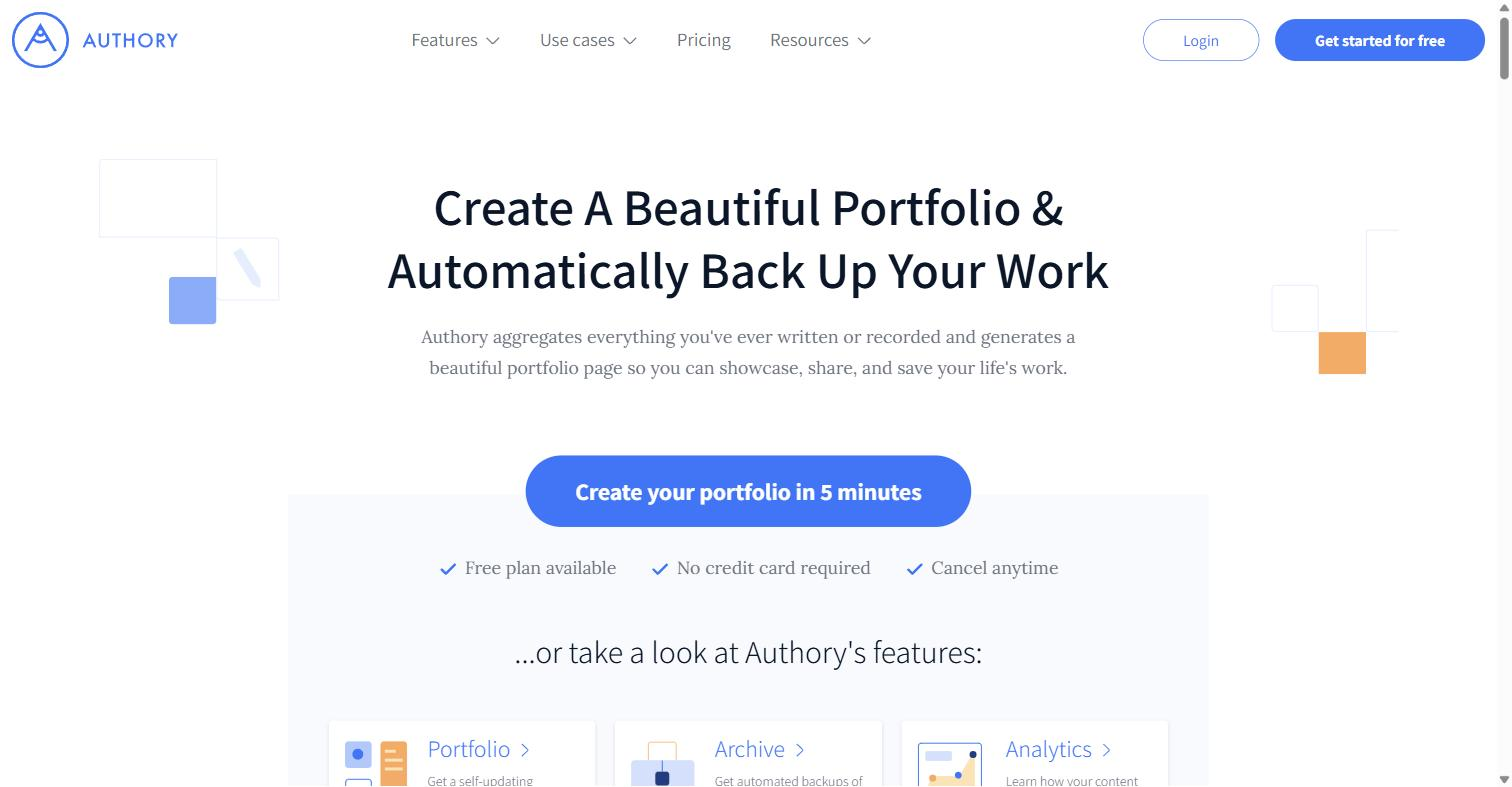
Authory is different from the others: it finds and backs up everything you've published, automatically. Connect your author pages and it imports your articles, including new ones as they appear, and keeps a copy even if the original publication disappears. Your portfolio is built from that archive, and readers can subscribe to get your new pieces by email.
Pricing: There's a free plan. Lite is $9 a month yearly ($108 a year). Standard, which adds a custom domain, is $15 a month yearly ($180 a year). Professional is $24 a month yearly.
Choose it if you publish a lot across many outlets and want a complete, backed-up record of it without adding each piece by hand. It's less suited to service-led copywriting portfolios with case studies and pricing.
5. Muck Rack
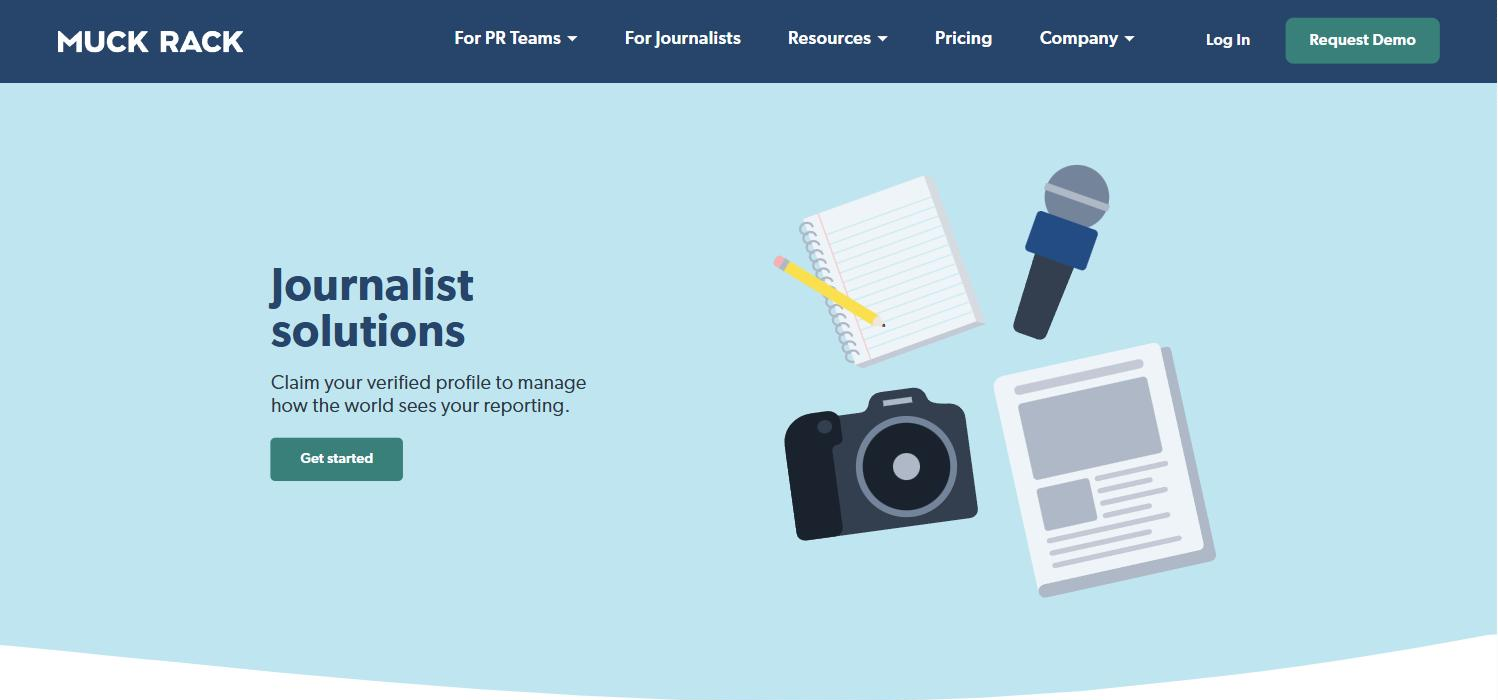
Muck Rack is a media database used by PR teams. Journalists get a free profile that lists their articles automatically, and those profiles show up when PR people search for writers on a beat.
Pricing: Free for journalists.
Choose it if you're a journalist and want to be found by PR people. Treat it as a second profile next to your own site, not a replacement: you can't use your own domain or change the design.
6. Carrd
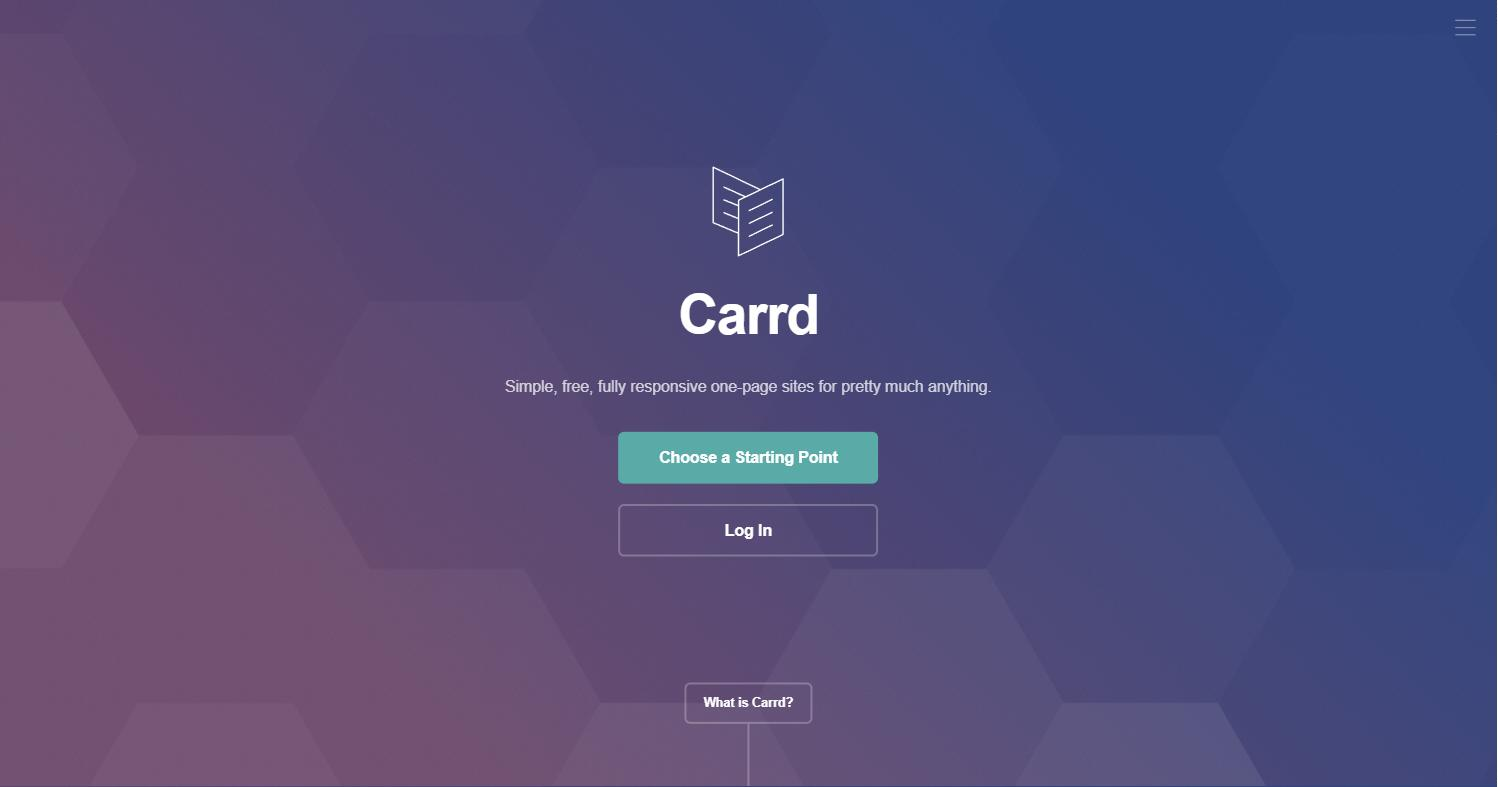
Carrd builds simple one-page sites. A writer can make a tidy page with a short bio, links to a handful of pieces and a contact form in an afternoon.
Pricing: Free on a carrd.co address. Pro Lite is $9 a year but has no custom domain or forms. Pro Standard, with your own domain and forms, is $19 a year. Pro Plus is $49 a year.
Choose it if you need something live today and a single page is enough. You'll outgrow it once you want case studies or a blog.
7. Squarespace
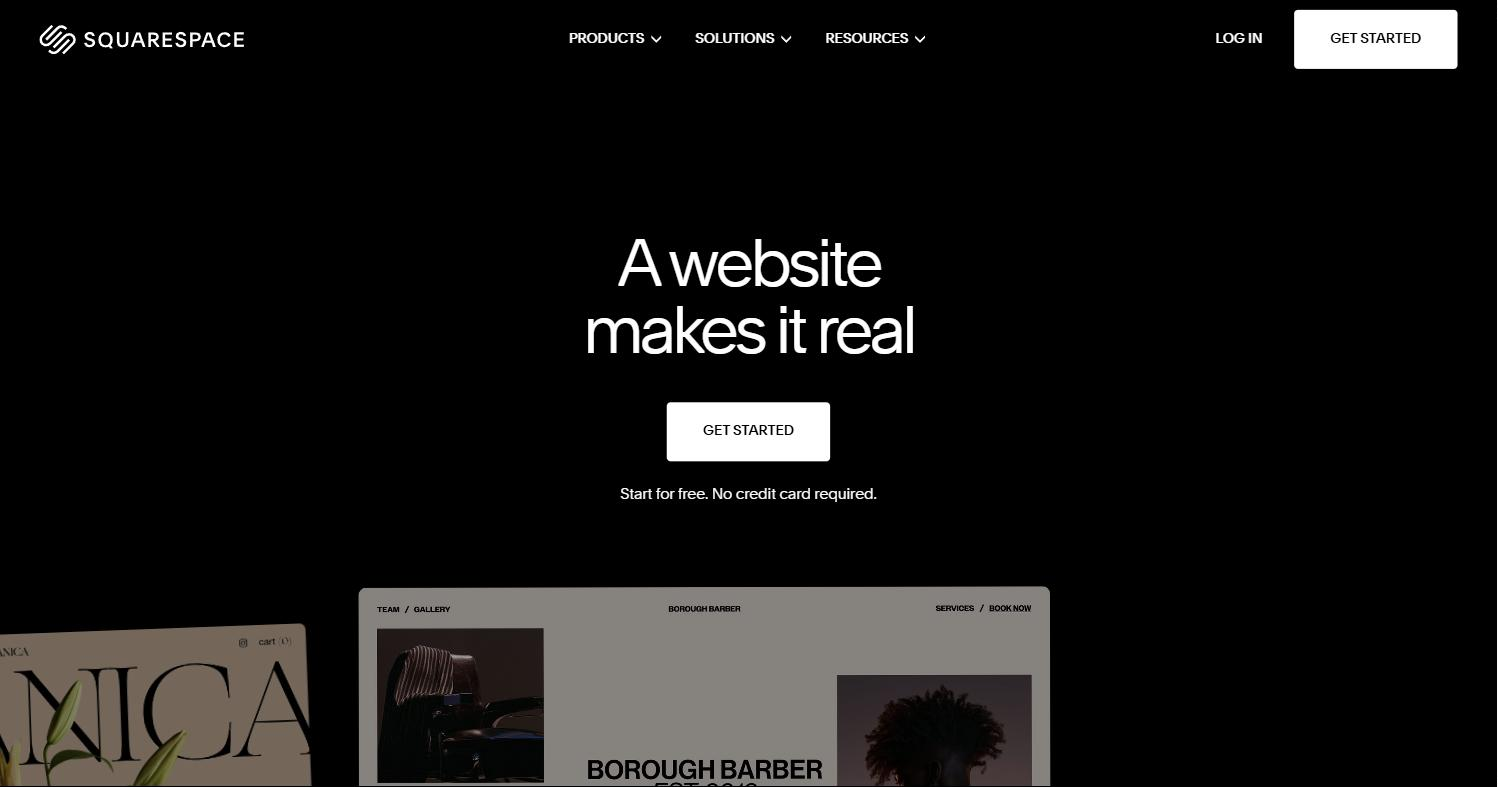
Squarespace is a general website builder with polished templates. Writers use it when the site needs to do more than show work: sell an ebook, take bookings for consultations, or run a members area.
Pricing: Basic is $19 a month on yearly billing ($228 a year), Core $29, Plus $49 and Advanced $99 a month. Yearly plans include a free domain for the first year. Email campaigns are an add-on.
Choose it if you want an all-in-one business site and the price doesn't matter much. For a portfolio alone, it's the most expensive option here.
What each one costs over a year
| Platform and plan | Year one | Each year after | Custom domain |
|---|---|---|---|
| Muck Rack | $0 | $0 | No |
| Carrd Pro Standard | $19 | $19 | Yes |
| Ghost on PikaPods, theme with Ectobuilder Pro | about $110 to $120 | about $30 to $40* | Yes |
| Copyfolio Premium | $108 | $108 | Yes |
| Journo Portfolio Pro | $120 | $120 | Yes |
| Authory Standard | $180 | $180 | Yes |
| Squarespace Basic | $228 | $228 | Yes |
* Plus $79 in any year you renew Ectobuilder Pro to change your design, or $199 once for Lifetime. Domain registration is extra everywhere except Squarespace's first year.
Our recommendation
- Just starting and want to be told what to put on your site? Copyfolio. It's made for this and the guidance is worth the price in year one.
- Want a portfolio, blog and newsletter you own, for the lowest long-term cost? Ghost with the Writer Portfolio theme. It does what Copyfolio does, adds a real newsletter, and drops to about $30 to $40 a year after the first.
- Mostly show published articles? Journo Portfolio, or Authory if you publish so much that adding pieces by hand is a chore.
- A journalist? Claim your free Muck Rack profile, whatever else you choose.
- Need something today for almost nothing? Carrd, then move when you outgrow one page.
Whichever you choose, keep copies of your work and your images outside the platform. If you ever switch, that's most of the job done.
Prices were checked on each provider's pricing page in October 2026 and may change; check before you sign up. Screenshots show each provider's public homepage in October 2026. Copyfolio, Journo Portfolio, Authory, Muck Rack, Carrd and Squarespace are trademarks of their owners. Ectobuilder is not affiliated with any of them.
Build your Ghost theme without code. Pick a theme from the Ectobuilder gallery or start from scratch, change it by clicking, and publish it to your Ghost site. Start free and only pay if you’re happy with it.
Written by
Founder of Ectobuilder, the AI-powered visual theme editor for Ghost. Indie software builder in Wrocław and co-author of The AdTech Book. I write about Ghost themes, newsletters and building websites with AI.
Comments
Questions or thoughts? Share them below.
Keep reading
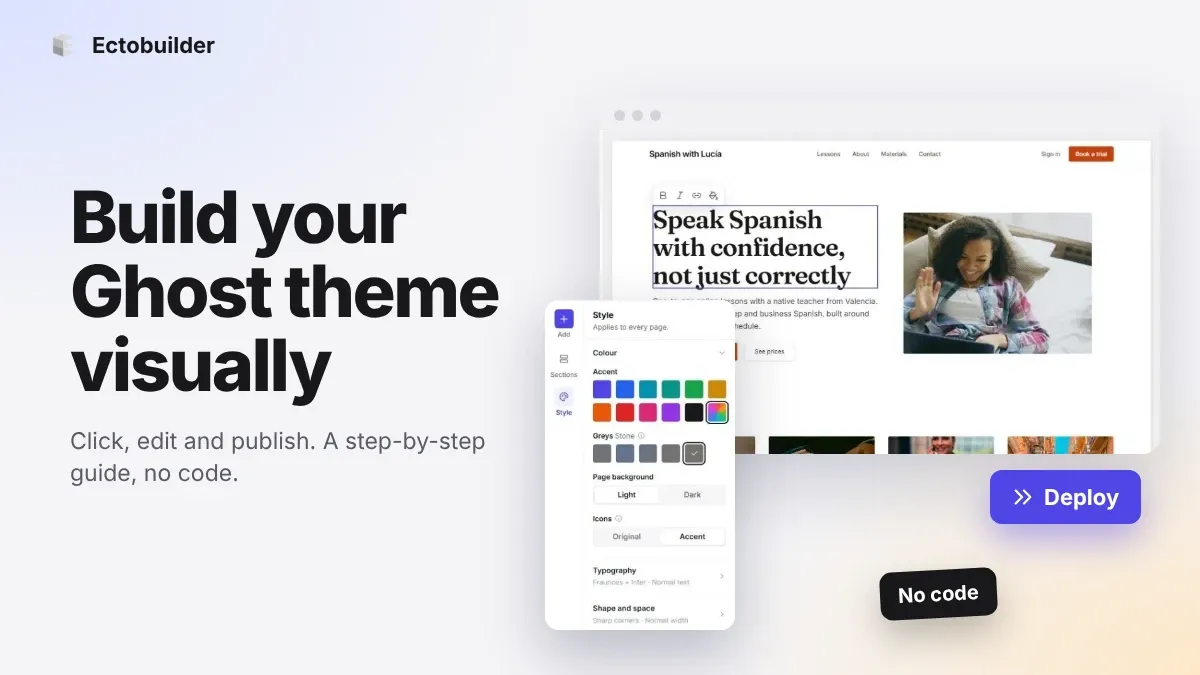
How to Build Your Ghost Theme Visually (Step-by-Step Guide, No Code)
Build a complete Ghost theme without touching code: start from a theme, edit text and pictures in place, add sections from a library of 270, set colours and fonts, design every page, and publish to Ghost in one click. Step by step, with screenshots.
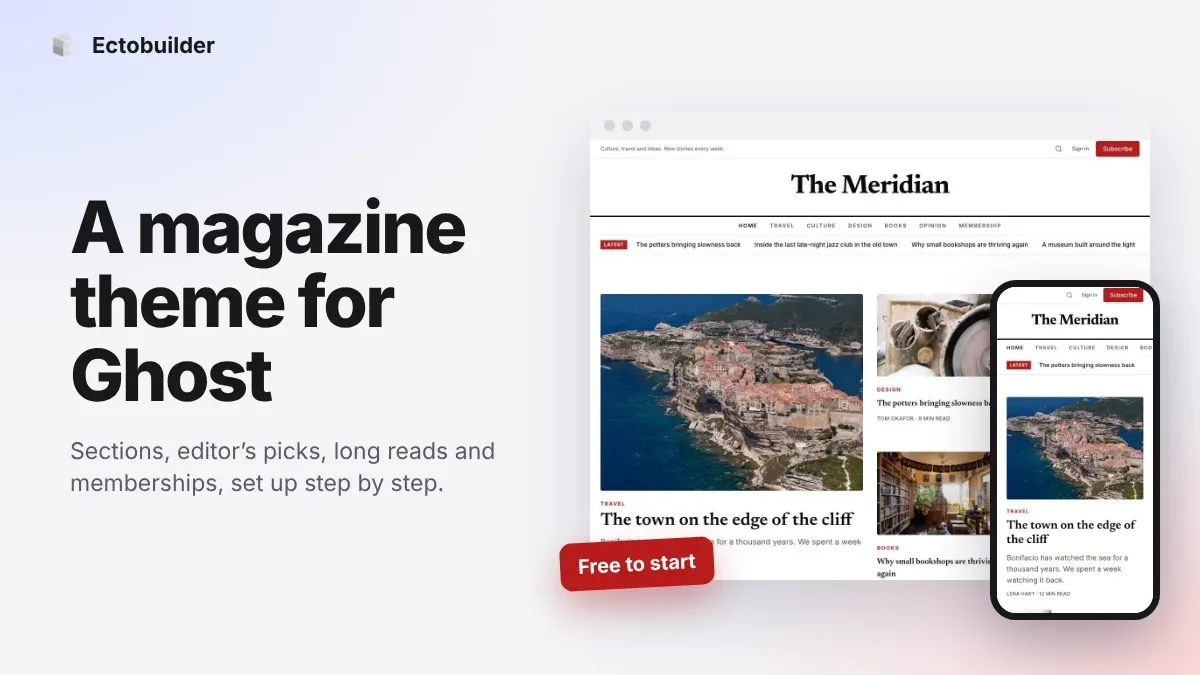
Magazine Theme for Ghost: Sections, Editor's Picks, Long Reads and Memberships
A step-by-step guide to the Magazine theme for Ghost: turn sections into tags, set up the navigation, fill the front page, editor's picks and section fronts, add your writers, sell memberships and send a weekly newsletter.
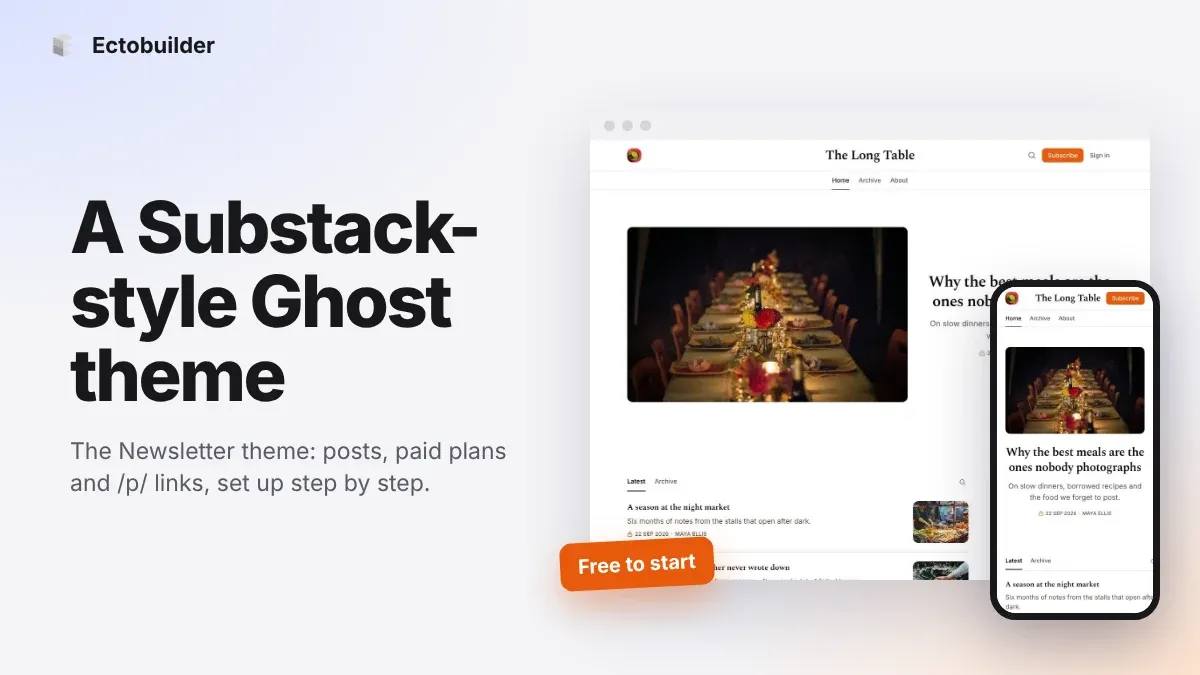
Newsletter Theme for Ghost: A Substack-Style Site With Paid Plans, /p/ Links and Comments
A step-by-step guide to the Newsletter theme for Ghost: a Substack-style homepage and reading page, then newsletters, paid plans, /p/ addresses, Plans, Welcome and About pages, comments and recommendations.