

Ghost is open source and MIT-licensed — you can download it, run it, and never pay Ghost anything. But the official managed host, Ghost(Pro), starts at $18/month billed yearly, and the plan most people actually need starts at $29/month.
That's $216 to $348 a year for a personal blog.
Meanwhile, the exact same Ghost, running the exact same code, costs about $2.50/month on PikaPods. Same admin panel, same editor, same themes, same everything.
This guide compares seven cheaper alternatives to Ghost(Pro), with real 2026 pricing. It also does the thing most hosting comparisons skip: adds up the total cost, including email, because email is where the "cheap" options quietly get expensive.
The short answer
| Option | From | Best for | |
|---|---|---|---|
| PikaPodsCheapest | ~$2.50/mo | No | Blogs, docs sites, portfolios |
| DigitalPress | Free / €1/mo | Limited | Testing Ghost before you commit |
| Magic PagesBest all-in | €13/mo | 10,000/mo | The best managed option |
| Typetale | $7/mo | Yes | Budget managed, EU servers |
| Midnight / FirePress | ~$10–19/mo | Yes | Zero setup, hand-held support |
| Railway / Fly.io | ~$5–10/mo | No | Developers who like a PaaS |
| Your own VPS | ~$5–7/mo | No | Multiple sites, full control |
| Ghost(Pro), for reference | $18/mo | Unlimited | Not thinking about any of this |
If you want the one-line answer: PikaPods is the cheapest credible Ghost host in 2026, and if you're building a web-first site rather than a high-volume newsletter, it will save you roughly $200 a year with almost no downside.
First, what are you actually paying for?
Every Ghost hosting bill is made of three things. Providers bundle them differently, which is why straight price comparisons mislead.
1. Compute and storage. A small server running Node.js and MySQL. Genuinely cheap — $2 to $7/month buys plenty for a site with normal traffic.
2. Email delivery. Ghost's newsletter feature sends through Mailgun, and on self-hosted installs you supply that account yourself. This is the line item that ruins budgets. More on it below.
3. Management. Updates, backups, SSL renewal, someone awake at 3 AM when the server dies. This is the real product Ghost(Pro) sells, and it's a legitimate thing to pay for.
Cheap hosts cut #3, and sometimes #2. Whether that's a good trade depends entirely on what kind of site you're running.
The Ghost(Pro) baseline (and the theme trap)
Before comparing alternatives, it's worth knowing precisely what Ghost(Pro) gives you, because one detail changes the whole calculation.
Ghost(Pro)'s published plans, billed yearly:
- Starter — $18/mo. One staff user, 1,000 members, 5MB file uploads, unlimited email sends.
- Publisher — $29/mo. Three staff users, 1,000 members, custom themes, paid subscriptions, integrations, the Admin API.
- Business — $199/mo. Fifteen staff, 10,000 members, priority support.
Here's the detail: Starter does not allow custom themes. Not marketplace themes, not themes you built yourself, not a theme you paid a designer for. You get the built-in default theme and its design settings. Paid subscriptions and tips aren't available on Starter either.
So the honest entry price for Ghost(Pro) — if you want your site to look like yours, or to charge money — is $29/month, or $348/year.
To be fair to Ghost: the Ghost Foundation is a non-profit, Ghost(Pro) revenue funds development of the software everyone else runs for free, and they charge 0% on subscription revenue where Substack takes 10%. Paying for Ghost(Pro) is a defensible choice. It just isn't the cheap choice, and on Starter it isn't the flexible one either.


1. PikaPods
Price: ~$2.50/month ⭐ Cheapest
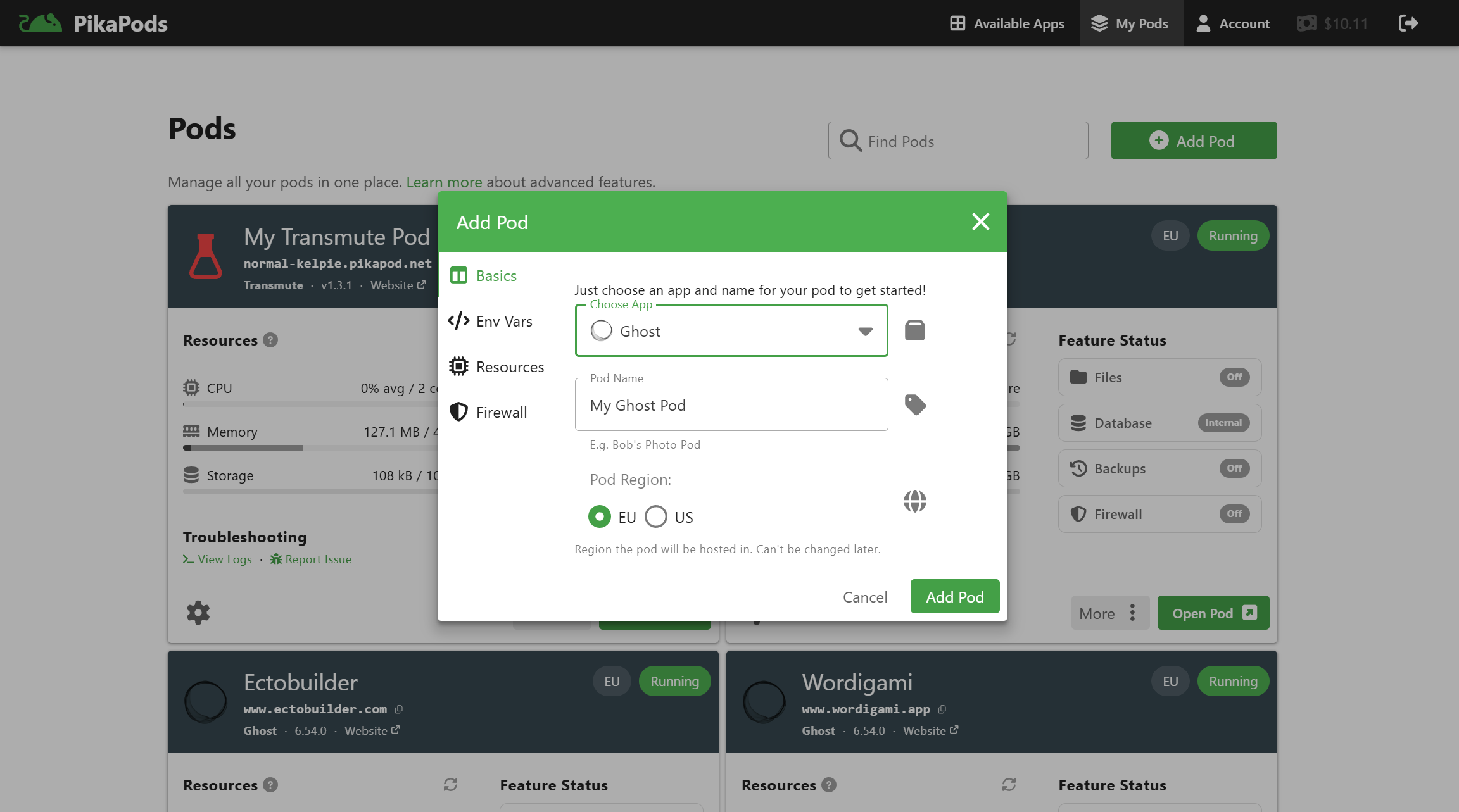
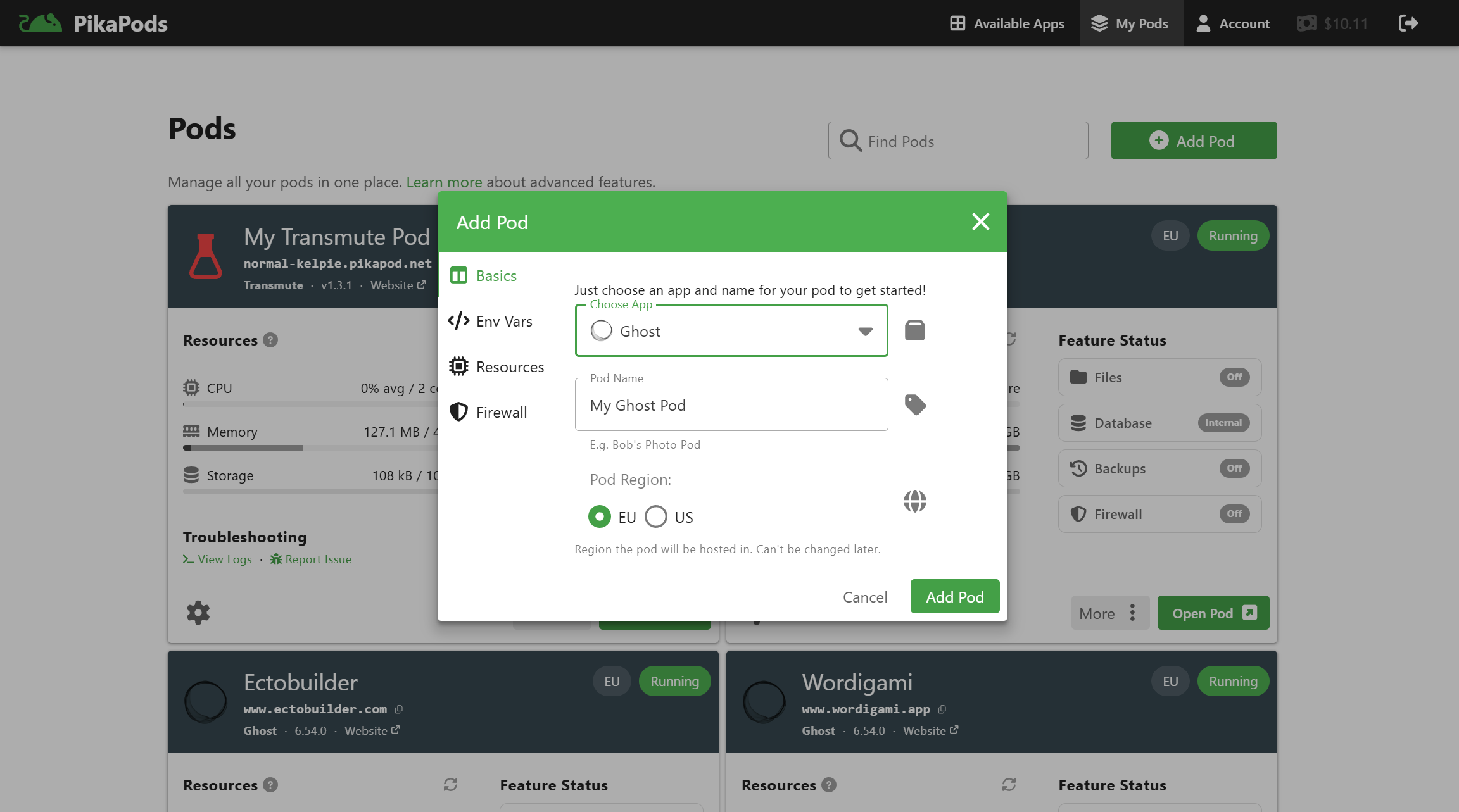
PikaPods isn't a Ghost host. It's a one-click platform for running open-source apps in containers, and Ghost happens to be one of a hundred-plus apps in its catalogue. Pricing is usage-based on CPU, memory, and storage, starting at $1.80/month with a $1/month floor per pod.
A typical Ghost pod — half a CPU, 1GB RAM, 5GB storage — lands around $2.50/month. Signup includes free credit, so you can try it without a card charge.
What you get: automatic app updates (usually within days of a Ghost release), automatic HTTPS, custom domain support, SFTP access for uploading themes and media, and a control panel that takes about three minutes from signup to a live site.
What you don't get:
- Email. Nothing is included. You bring a Mailgun account.
- Real backups. PikaPods snapshots exist for infrastructure failure, not for you. You want manual exports over SFTP or an S3 bucket you configure yourself.
- Anyone watching. Users have reported multi-hour outages from host hardware failures. No SLA, no one paging themselves at 3 AM.
- Guaranteed pricing. New pods get current-year pricing; existing pods roll forward a version at each adjustment. Predictable, but not frozen.
Who it's for: personal blogs, documentation sites, portfolios, project sites, and anything where a few hours of downtime is annoying rather than expensive. Also excellent as a staging environment for a site hosted elsewhere.
Who should skip it: anyone running a business-critical publication or a monetised newsletter. At $2.50/month you are not buying reliability, and it's unfair to expect it.
Ghost setup notes (themes, SFTP, MinIO, Mailgun)

2. DigitalPress
Price: free tier, paid from about €1/month
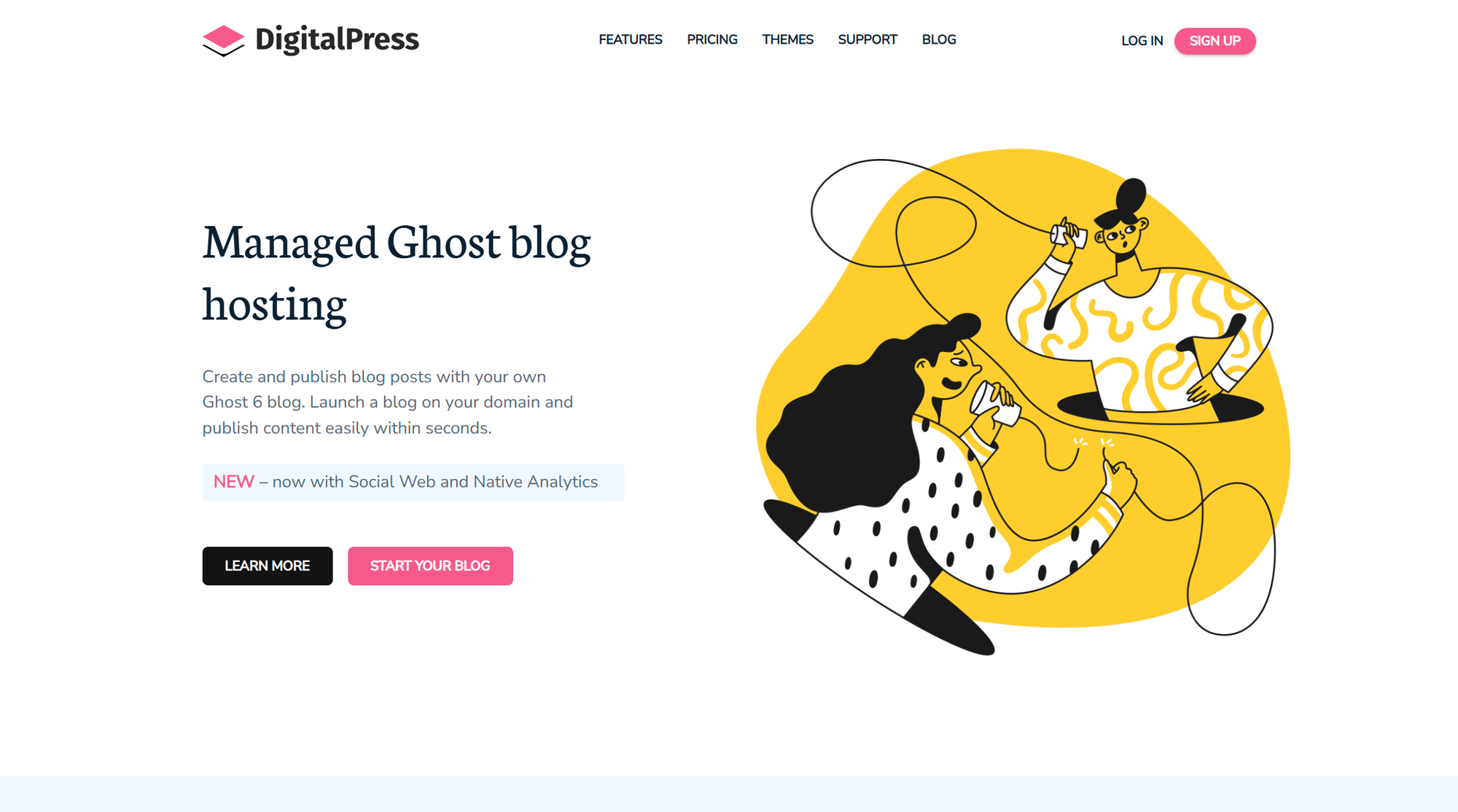
DigitalPress has been doing Ghost hosting for years and still runs a genuinely free tier. The free plan is ad-supported with limited storage and a curated theme selection — not suitable for a real audience, but the best zero-commitment way to click around inside a live Ghost install before deciding anything.
Paid plans start at around €1/month and remove the ads and restrictions.
Who it's for: evaluating Ghost. Spin one up, write three posts, decide whether the editor suits you, then migrate to a real host with Ghost's built-in JSON export.


3. Magic Pages
Price: €13/month (~$15) 🏆 Best all-in
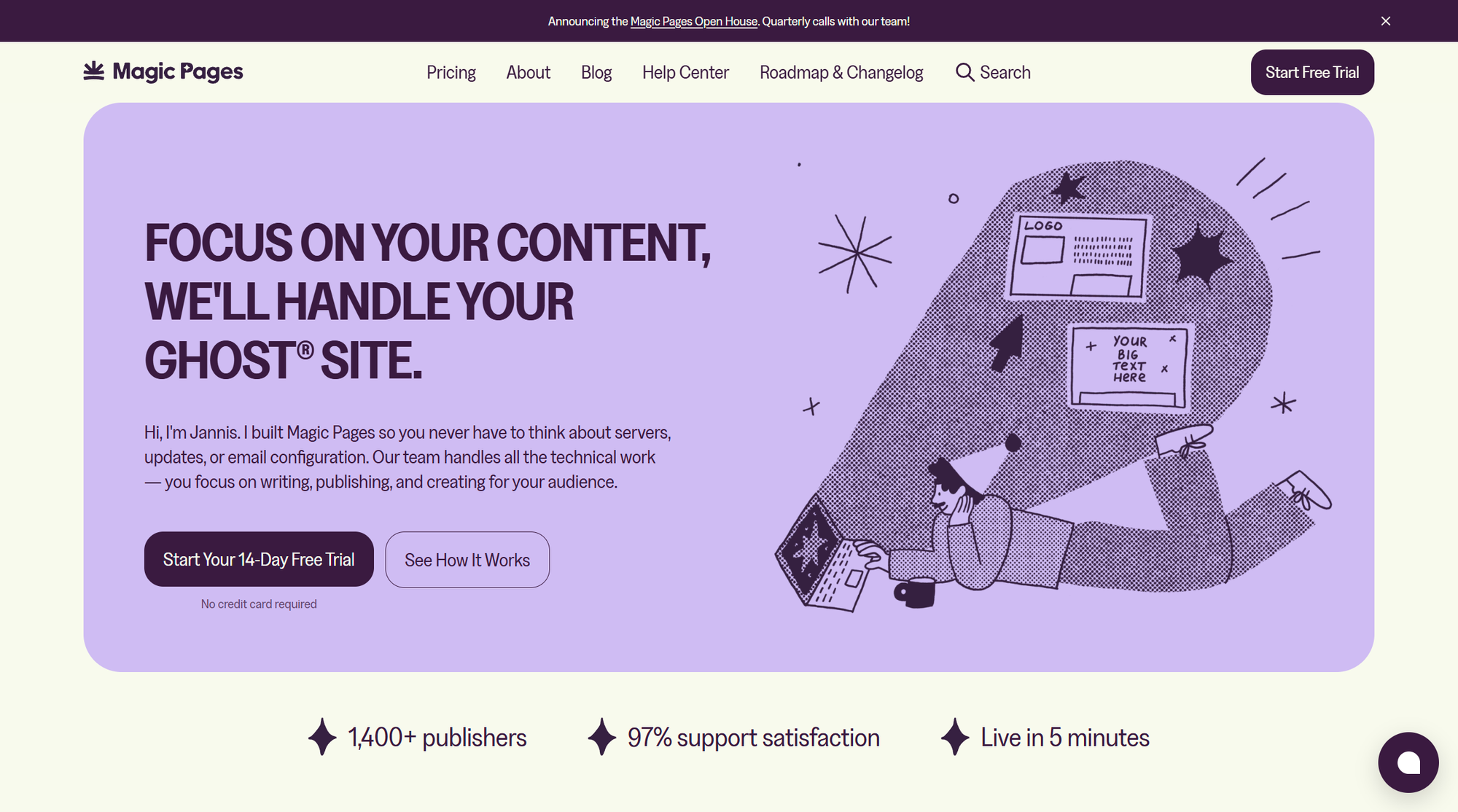
Magic Pages is run by Jannis Fedoruk-Betschki, who is active in the Ghost community and now hosts well over a thousand sites. In March 2026 the plan structure was simplified into a single tier at €13/month, €130/year, or €390 lifetime.
That single plan includes everything: full CDN, custom themes, 10,000 newsletter emails per month, backups, updates, SSL, a 99.9% uptime SLA on monthly and yearly plans, and support from an actual human who knows Ghost. Overages run $5 per additional 10,000 emails. There's a 14-day trial with no card required.
This is the option to pick if you want the Ghost(Pro) experience without the Ghost(Pro) bill. At €130/year against Ghost(Pro) Publisher's $348, you save roughly $200 and lose essentially nothing — you gain custom themes, which Ghost(Pro) Starter doesn't offer at all.
The lifetime plan at €390 is worth a serious look if you're confident about the project. It pays for itself against Ghost(Pro) Publisher in about fourteen months.
The honest caveat: it's a small team. That's a genuine strength on support responsiveness and a genuine risk on bus factor. Keep your exports.


4. Typetale
Price: from $7/month
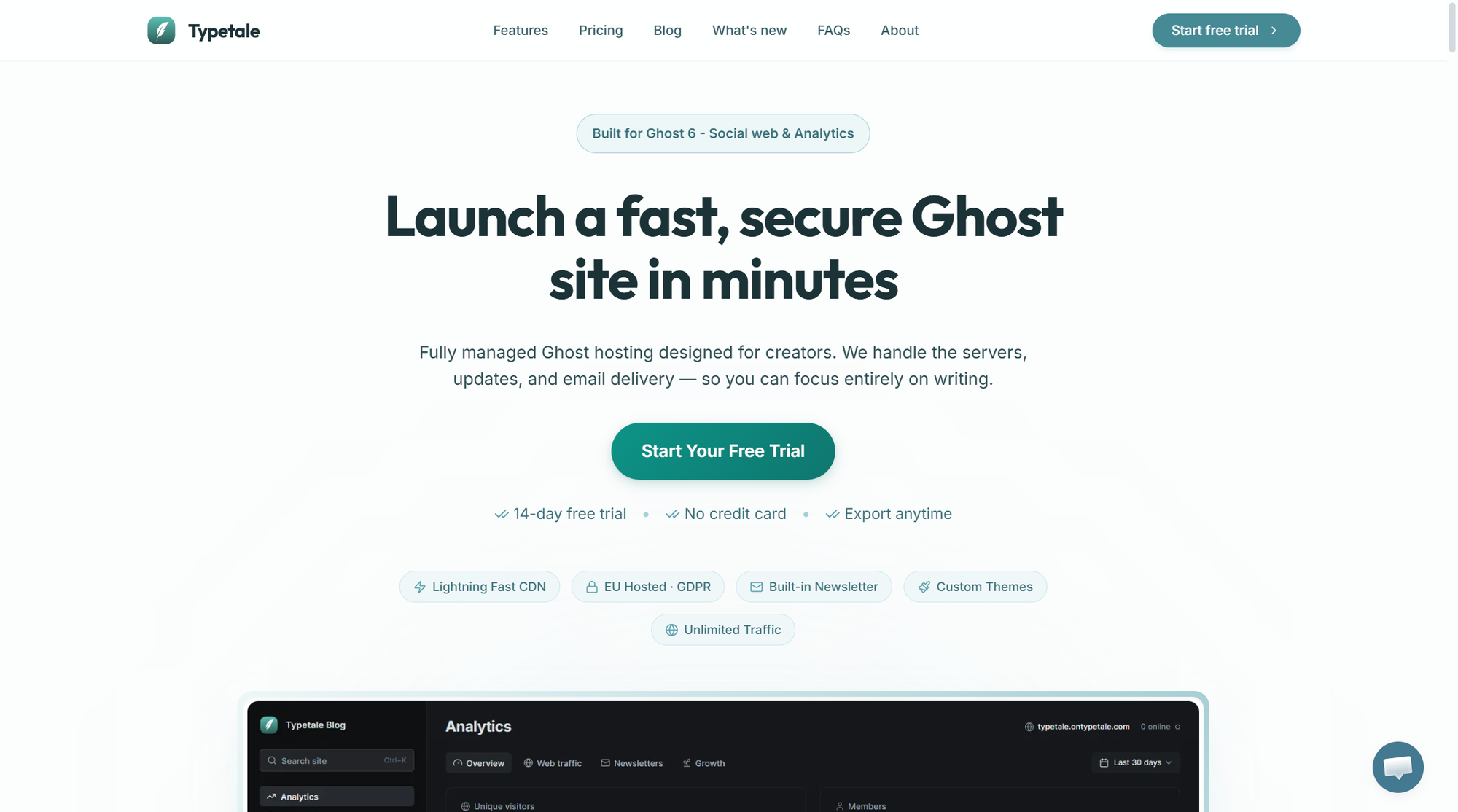
A newer indie host running on EU servers, with plans from $7/month including email. Less established than Magic Pages, but the price sits neatly between PikaPods' DIY and Magic Pages' full service.
Who it's for: people who want managed hosting with email included and are comfortable betting on a newer provider.
 Typetale Team
5. Midnight and FirePress
Price: Roughly $10–19/month

 FirePress Team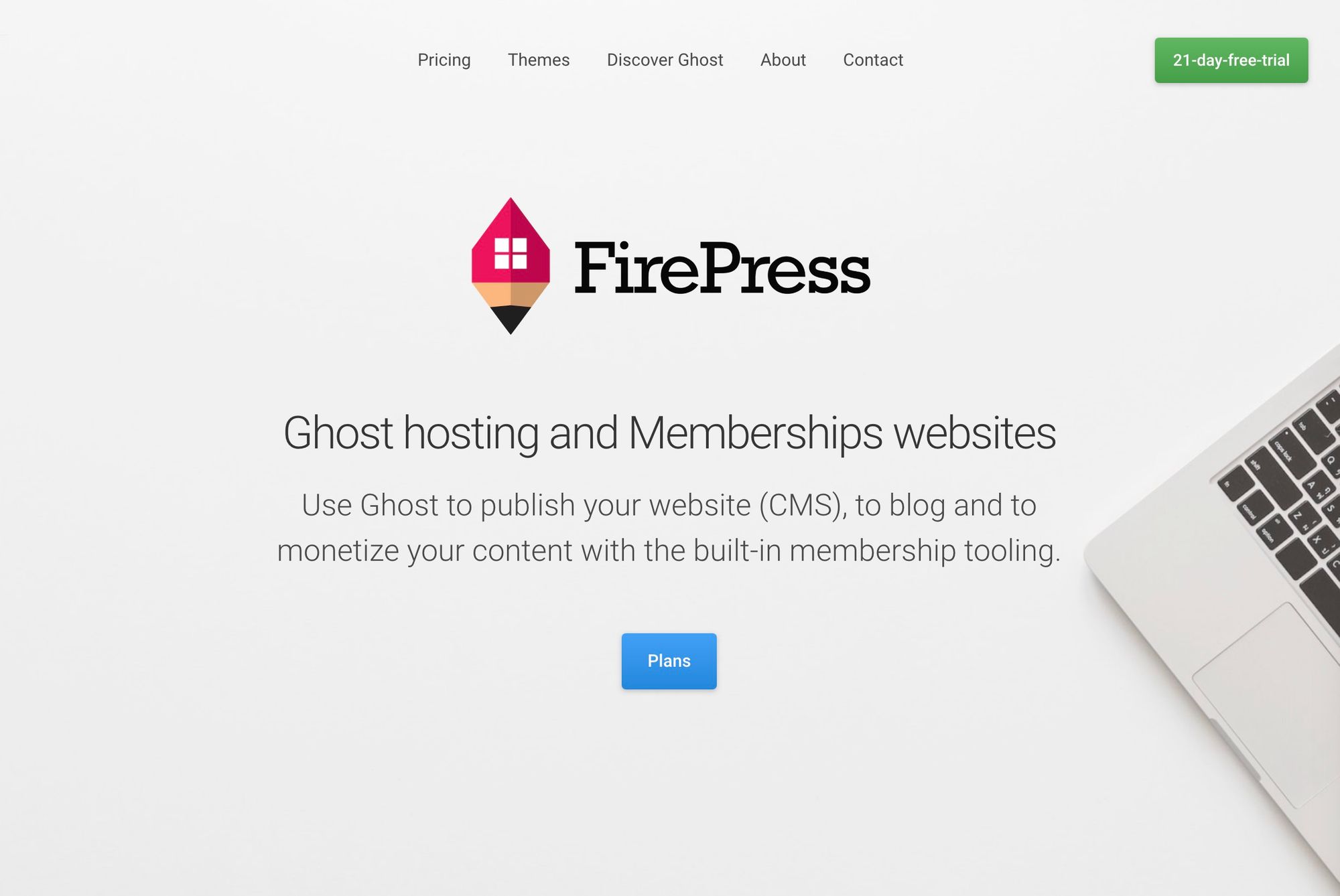
Both position themselves as zero-setup managed Ghost hosting: pre-configured installs, automatic SSL, daily backups, no database or DNS wrangling. FirePress adds Cloudflare CDN caching by default and runs a long free trial.
They aren't the cheapest, but they're the friendliest for someone who has never touched a server and doesn't want to start. The pitch is "we'll hold your hand," and they deliver on it.
6. Railway and Fly.io
Price: $5–10/month

Developer platforms rather than Ghost hosts. You deploy a container, wire up a MySQL instance and a persistent volume, point DNS at it, and you're running. Fly.io's allowances make a very small Ghost site nearly free.
The catch: you own the entire stack. Persistent volumes need configuring correctly or you lose uploads on redeploy. Database backups are yours. Ghost upgrades are yours. Email is yours. This is self-hosting with nicer ergonomics, not managed hosting.
Who it's for: developers who already use these platforms and will genuinely enjoy the setup. Everyone else should take PikaPods and spend the saved afternoon writing.
7. Your own VPS
Price: $5–7/month
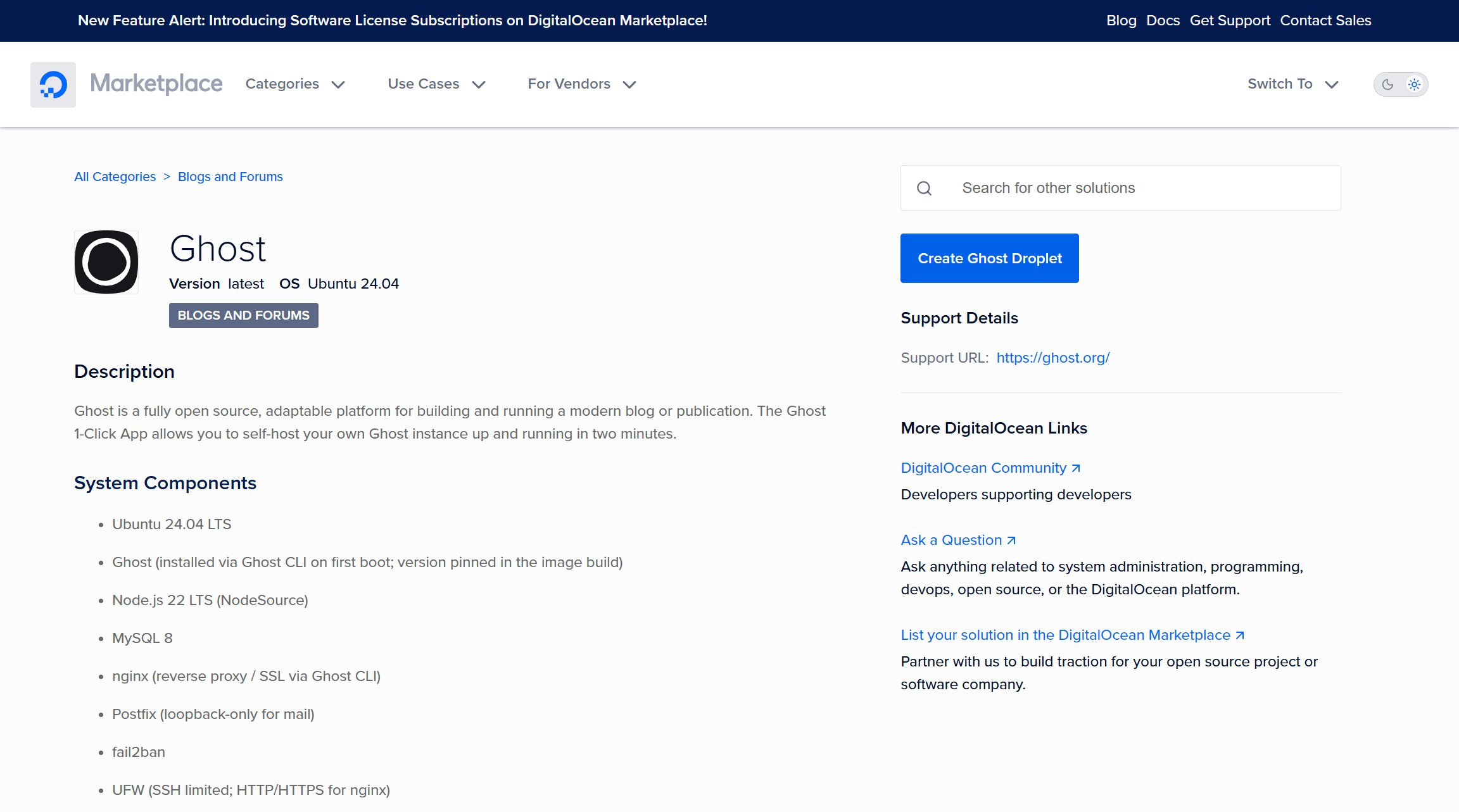
Hetzner, DigitalOcean, Vultr, Netcup. Full root access, and the cheapest per-unit compute you'll find anywhere.
Three things to know before you go this route:
- Buy 2GB of RAM, not 1GB. Ghost plus MySQL will technically boot on 1GB and then get MySQL killed by the OOM reaper under load, taking your site down. The $4 tier is a false economy; budget $6–7.
- Use Docker Compose. It's now the primary install path for Ghost 6, with Ghost-CLI becoming legacy. A Compose file with Ghost, MySQL 8, and Caddy for automatic SSL is about forty lines and reproducible.
- Skip ARM if you want ActivityPub. Ghost's ActivityPub containers require AMD64, which rules out Hetzner's ARM-based CAX line and similar.
Who it's for: anyone running two or more Ghost sites. Amortised across three sites, a €6 Hetzner box is the cheapest option in this entire article. For a single site it is not worth the maintenance.
The hidden cost: email
Here's the part that reorders the whole table.
Ghost sends newsletters through Mailgun. Ghost(Pro) and most managed hosts bundle this. PikaPods, Railway, Fly, and any VPS do not — you open your own Mailgun account and pay separately.
Mailgun's 2026 pricing:
| Plan | Price | Included | Overage |
|---|---|---|---|
| Free | $0 | 100 per day | Hard cap |
| Basic | $15/mo | 10,000/mo | $1.80 / 1,000 |
| Foundation | $35/mo | 50,000/mo | $1.30 / 1,000 |
| Scale | $90/mo | 100,000/mo | $1.10 / 1,000 |
The legacy pay-as-you-go Flex plan was discontinued in December 2025, and per-email pricing roughly doubled at the same time.
Watch the free tier's shape. It's 100 emails per day, not per month, and it's a hard ceiling with no overage. If you have 150 subscribers and send one weekly issue, the free tier cannot deliver it. Not "will cost extra" — cannot. Any newsletter with more than about 100 subscribers needs the $15/month Basic plan.
That $15 is larger than the entire PikaPods bill, and it's why the answer to "what's the cheapest Ghost hosting" genuinely depends on whether you send email.
What it actually costs: three scenarios
Scenario 1: A personal blog, no newsletter
You're publishing to the web. Members and email are off.
| Setup | Monthly | Yearly |
|---|---|---|
| PikaPods + domain | ~$3.50 | ~$42 |
| Magic Pages + domain | ~$16 | ~$192 |
| Ghost(Pro) Starter + domain — default theme only | ~$19 | ~$228 |
| Ghost(Pro) Publisher + domain | ~$30 | ~$360 |
PikaPods wins by a mile — around $300/year cheaper than Ghost(Pro) Publisher, and unlike Ghost(Pro) Starter you can install any theme you like. This is the single strongest case for cheap Ghost hosting.
Scenario 2: A small newsletter — 500 subscribers, weekly
About 2,200 emails a month. Above the Mailgun free cap, comfortably inside Basic.
| Setup | Monthly | Yearly |
|---|---|---|
| PikaPods + Mailgun Basic | ~$17.50 | ~$210 |
| Magic Pages — email included | ~$15 | ~$180 |
| Ghost(Pro) Publisher | $29 | $348 |
The DIY advantage collapses the moment email enters the picture. Magic Pages is the value pick here — it's cheaper than PikaPods plus Mailgun and fully managed. Ghost(Pro) Publisher still costs nearly double, though it does add unlimited sends and native paid subscriptions.
Scenario 3: A growing publication — 5,000 members, weekly email
About 21,600 emails a month, which pushes past Mailgun Basic's allowance into Foundation territory at $35.
| Setup | Monthly | Yearly |
|---|---|---|
| PikaPods + Mailgun Foundation | ~$38 | ~$456 |
| Magic Pages + email overage | ~$21 | ~$252 |
| Ghost(Pro) Publisher — scales with members | — | from $348 |
At this scale self-hosting stops saving money, because Mailgun's flat-rate tiers are worse value than a managed host's bundled allowance. Magic Pages stays cheapest; Ghost(Pro) becomes genuinely competitive.
The pattern: cheap hosting wins decisively for web-first sites, wins narrowly for small newsletters, and stops winning at volume. Pick based on how much email you send, not on the headline hosting price.
Where the savings actually go
Say you take the obvious win — PikaPods for a personal site — and pocket roughly $300 a year against Ghost(Pro) Publisher.
Then you go looking for a theme, and the marketplace wants $49 to $149 for a one-off design that a few thousand other Ghost sites are also running. Or you learn Handlebars, routes.yaml, and gscan well enough to build one, which is a real skill and a real weekend or six.
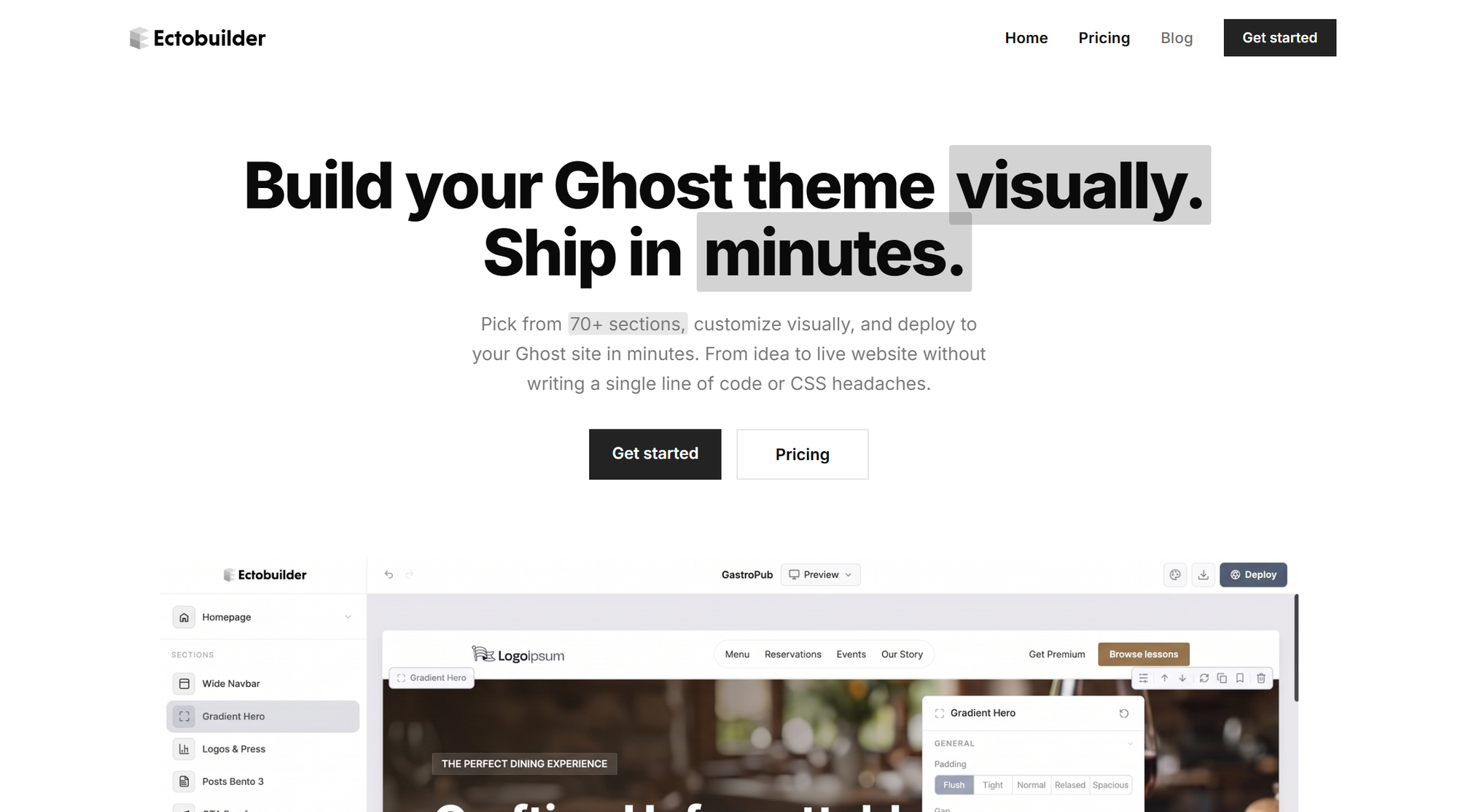
That's the gap Ectobuilder exists to close. You compose a Ghost theme from parameterised sections in a visual editor, customise the copy, colours, and layout, and export a valid .zip you upload to any Ghost install — PikaPods, Magic Pages, your own VPS, or Ghost(Pro) Publisher. No Handlebars required. The free tier builds and exports one complete theme.
Cheap hosting and a theme that doesn't look like everyone else's are not a trade-off you have to make.
FAQ
What is the cheapest Ghost hosting?
PikaPods, at roughly $2.50/month for a small Ghost site. It's usage-based container hosting starting at $1.80/month, with a $1/month per-pod minimum. Newsletter email is not included.
Is Ghost free to self-host?
The software is free and open source. Running it is not: budget $5–7/month for a server with enough RAM, plus Mailgun from $15/month if you send newsletters, plus your own time for updates and backups.
Can I use a custom theme on Ghost(Pro) Starter?
No. Custom themes and marketplace themes both require the Publisher plan at $29/month or above. Starter gives you the built-in default theme and its design settings only. Every third-party host in this comparison allows custom themes on its entry plan.
Do I need Mailgun for Ghost?
Only if you send newsletters. Ghost's bulk email integration is Mailgun-specific, so self-hosted installs need an account. Managed hosts like Magic Pages and Ghost(Pro) bundle delivery instead.
Can I move my Ghost site between hosts?
Yes, and it's one of Ghost's best qualities. Export a JSON file of your content from Ghost admin, copy your content/images, content/media, and content/themes directories over SFTP, and import on the new host. Most migrations take under an hour.
How much RAM does Ghost need?
2GB is the safe number for Ghost plus MySQL. 1GB works until traffic spikes, then MySQL gets killed and the site goes down. Choose 4GB for high-traffic sites or several staff users.